
The SaaS Validation Framework: From Signal to Conviction
How Gaplyze's multi-source intelligence methodology synthesizes signals from seven real-time sources, scores ideas across eight dimensions, and produces the structured conviction you need before investing a single weekend building.
Table of Contents
Why Most SaaS Ideas Fail Before Launch
The graveyard of failed SaaS startups is not filled with bad ideas. It is filled with unvalidated ideas. Founders who built exactly what they imagined, shipped on time, and watched as nobody came. The product worked perfectly — it just solved a problem nobody was willing to pay to solve.
The validation gap is the single most dangerous phase of any SaaS journey. It is the space between 'I have an idea' and 'I have evidence that this idea solves a real, urgent problem for a specific group of people who are actively seeking a solution.' Most founders skip this phase entirely or reduce it to a quick Google search and a conversation with friends.
Gaplyze was built to close this gap. Instead of spending months on manual research that produces unstructured notes, Gaplyze runs a comprehensive multi-source intelligence operation that scores, analyzes, and maps your opportunity — producing the structured conviction you need to commit or move on.
Validation is not about proving your idea is right. It is about reaching a conviction threshold — the point where evidence is strong enough to justify the investment of your time and energy. Gaplyze's structured scoring and multi-source analysis tells you exactly when you have crossed that threshold and when you have not.
How Gaplyze's Multi-Source Intelligence Works
Single-source validation is dangerous. If you only check Google Trends, you might chase a seasonal spike. If you only read Reddit threads, you might build for a vocal minority. If you only study competitors, you might copy the wrong strategy. Each source tells a partial story.
Gaplyze eliminates this risk by synthesizing intelligence from seven real-time sources simultaneously in every Market Intelligence. The Trend Scanner pulls live signals from Google Trends, Product Hunt, Reddit, Twitter/X, VC funding databases, GitHub, and Hacker News — and synthesizes them into a single, coherent intelligence picture.
The power of Gaplyze's approach lies in signal convergence. When the Trend Scanner shows rising search demand, Reddit threads reveal complaints about existing solutions, VC funding is flowing into the space, and the Market Gap Analyzer identifies specific unmet needs — those converging signals create the kind of conviction that no single source could provide alone.
The Seven Intelligence Sources Gaplyze Monitors
Google Trends — Search Demand Signals
Gaplyze analyzes Google Trends to detect what people are actively searching for in your market. Rising search volume indicates growing awareness and demand. The Trend Scanner specifically looks for problem-oriented queries — the searches that indicate unmet need rather than existing awareness.
Product Hunt — Recent Launch Activity
Gaplyze monitors Product Hunt launches in your market space to understand what is being built, what is getting traction, and where the community sees innovation opportunities. Recent launches with strong engagement signal validated categories. Gaps in launch activity signal opportunities.
Reddit — Community Pain Points
Gaplyze mines Reddit communities (r/startups, r/SaaS, r/Entrepreneur, and niche-specific subreddits) for recurring frustrations and workarounds. The most valuable signals come from people describing manual processes they have built because no adequate solution exists — workarounds are evidence of demand.
Twitter/X — Tech Community Sentiment
Gaplyze's Social Media Intelligence tracks Twitter/X tech community discussions to detect emerging themes, influencer sentiment, and conversation volume around your market space. Topics gaining traction among builders today become mainstream demand within months.
VC Funding — Investment Activity
Gaplyze tracks venture capital flows into your market segment. Rising investment signals institutional validation. But the analysis also watches for over-investment — a market flooded with well-funded competitors is harder to enter than one with moderate activity.
GitHub — Developer Activity
Gaplyze monitors GitHub activity in your technology space to detect developer interest, open-source alternatives, and technical feasibility signals. Rising GitHub activity around related technologies suggests a growing developer ecosystem that could support your product.
Hacker News — Technical Discussions
Gaplyze analyzes Hacker News discussions to capture developer sentiment, technical critiques of existing solutions, and emerging technology trends. The Hacker News community is an early indicator of technical shifts that create new market opportunities.
“A single signal can mislead you. Gaplyze synthesizes seven independent sources into a single analysis — creating the kind of converging evidence you can build a company on.”
How Gaplyze Turns Signals into Structured Analysis
Raw signals are ingredients. Gaplyze's analysis framework is the recipe. The Market Intelligence takes signals from all seven sources and synthesizes them into a comprehensive intelligence report that answers five fundamental questions: Is there genuine demand? How intense is the competition? Can a small team execute? What is the right positioning? And what should you build first?
The demand question draws on the Trend Scanner's search patterns, Reddit community pain points, and the Market Gap Analyzer's review sentiment analysis. The competition question draws on competitor scanning, funding activity, and competitive landscape mapping. The execution question combines competitive gaps with Gaplyze's feasibility scoring. The positioning question emerges from the Market Gap Analyzer's underserved audience detection and feature gap mapping.
Every Market Intelligence produces this synthesis automatically. What would take weeks of manual research — scanning seven sources, cross-referencing findings, identifying convergence patterns — Gaplyze produces in a single structured analysis session. And because the output follows the same comprehensive framework every time, you can compare analyses across ideas and make rational decisions.
Explore markets and find your winning idea
Explore a niche or topic, shortlist the strongest opportunities, then run a full Market Intelligence for comprehensive scores and a full business blueprint.
Scoring: How Gaplyze Quantifies Your Opportunity
One of the most dangerous aspects of unstructured validation is the absence of scoring. Without scores, you are comparing feelings. Gaplyze eliminates this by evaluating every idea across eight distinct dimensions through the Idea Score feature.
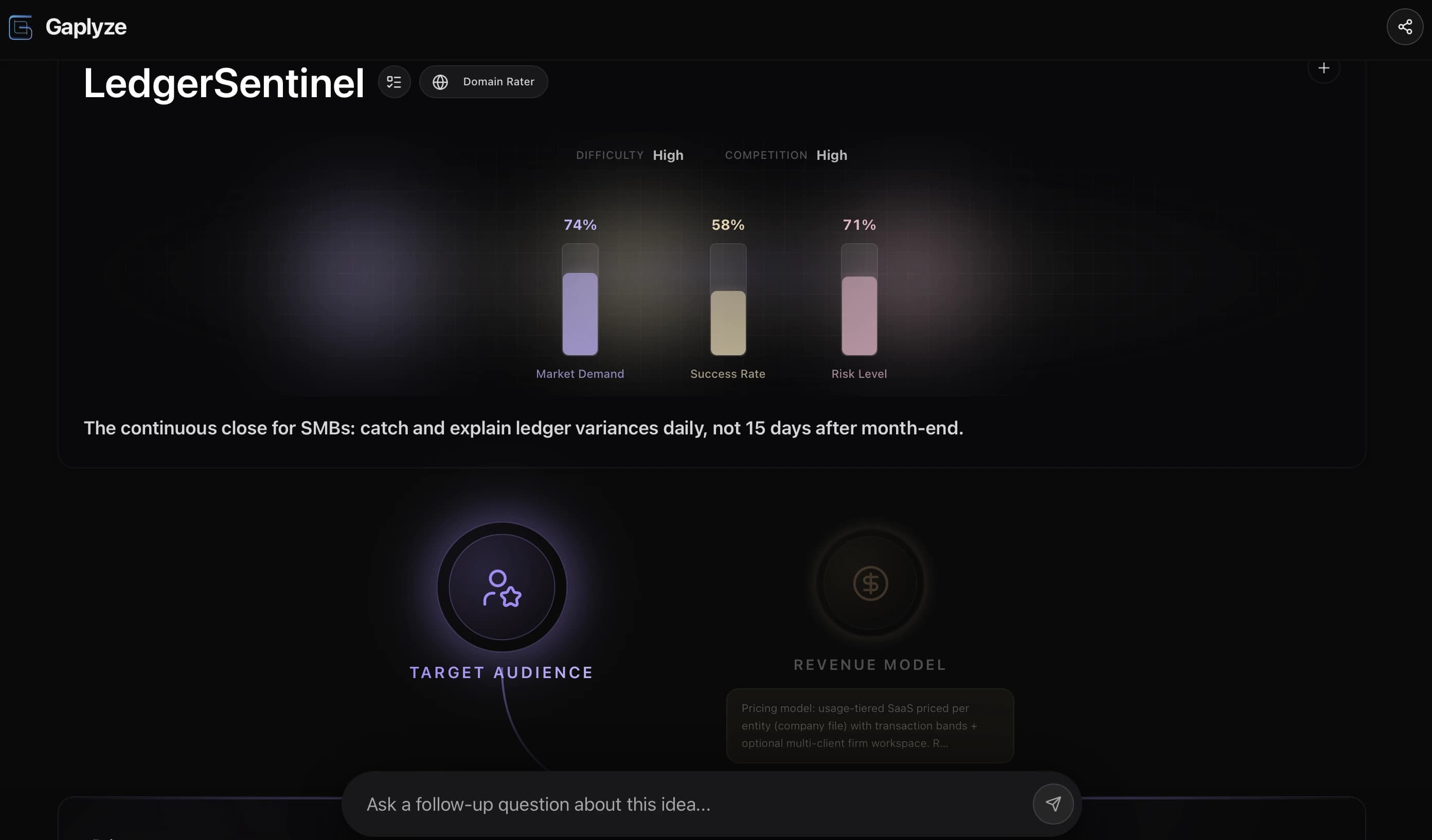
The eight dimensions — market demand, success probability, competition level, innovation potential, scalability, time to market, cost efficiency, and risk level — each capture a different aspect of the opportunity. Together, they produce a multi-dimensional profile that reveals not just whether an idea is strong, but why it is strong and where its vulnerabilities are.
Idea Score also generates a complete SWOT analysis with a weighted recommendation. When you see that an idea scores high on demand but low on execution feasibility, you have a specific question to answer: Can you overcome the execution challenge? If yes, you have found a defended opportunity. If no, you know exactly why you are moving on.
Gaplyze's scoring enables portfolio thinking. When you evaluate multiple ideas — and you should — structured scores let you compare across ideas using identical criteria. The idea that looked strongest in conversation might score weakest on competition. The idea you almost dismissed might have the strongest demand signals. Gaplyze's scores surface what intuition misses.
The Validation Loop: How Gaplyze Supports Iterative Discovery
Validation is not a gate you pass through once. It is a loop you repeat as your understanding deepens. Gaplyze supports this iterative approach through several key features designed for progressive refinement.
Start broad with idea generation: enter a topic and Gaplyze produces specific business opportunities by scanning all seven sources. Use Idea Score to score the most promising concepts. Then run a full Market Intelligence on your top candidates for comprehensive market intelligence.
Use Gaplyze's follow-up chat to probe specific questions that emerge from your analysis. The chat has full context of your Market Intelligence — your competitive landscape, scoring dimensions, market gaps, and positioning — so you can dig deeper without re-explaining anything. Ask about specific competitors, explore alternative segments, or pressure-test your assumptions.
Gaplyze's persistent workspaces preserve your entire research journey. Create themed workspaces to organize analyses by market, by timeframe, or by priority. Every analysis, score, and follow-up is saved and searchable. This transforms validation from a one-shot exercise into an ongoing intelligence operation that builds conviction through structured repetition.
Your first validation pass should take no more than two hours. Start with idea generation or Idea Score for initial scoring. Run a Market Intelligence on the strongest candidate. Use follow-up chat to probe the key questions. Check the Public Ideas to see what other founders are discovering in the same space. If the signals converge positively, go deeper. If they diverge, move on. Gaplyze compresses weeks of manual research into a structured sprint.
From Validation to Execution with Gaplyze
The ultimate test of a validation framework is whether it produces actionable output. Knowing that your idea is validated is necessary but insufficient. You also need to know what to build first, who to target, how to position, and what your first milestone should be.
Gaplyze bridges the gap between intelligence and execution directly. After your Market Intelligence, generate an execution roadmap — a prioritized action plan with specific tasks, time estimates, and strategic rationale drawn from your market intelligence. The roadmap is not generic advice — it is a step-by-step plan informed by your competitive landscape, your Market Gap Analyzer findings, and your positioning opportunities.
The execution roadmap becomes a drag-and-drop todo board where you track progress. Pro users can export the entire plan to clean markdown for their project management tool. And Gaplyze's Domain Rater evaluates potential domain names against your specific business positioning — because even your brand choice should be informed by market intelligence.
This end-to-end workflow — from idea generation through multi-source analysis through scoring through execution roadmap — is what makes Gaplyze a validation framework, not just a research tool. Every step produces structured output that feeds the next step. No gaps. No blank pages. No guesswork.
Building Your Validation Practice with Gaplyze
Validation is not a one-time skill. It is a practice that improves with repetition. The more ideas you evaluate with Gaplyze, the faster you develop pattern recognition — the ability to spot strong signals and dismiss noise at a glance.
Start now. Enter your current idea into Idea Score for a quick multi-dimensional evaluation. If the scores are promising, run a Market Intelligence with the full seven-source Trend Scanner and Market Gap Analyzer. Use the follow-up chat to probe the questions that matter most. Generate an execution roadmap. Check the Public Ideas for community signals.
Then do it again with your next idea. And your next. With Gaplyze, each iteration takes minutes instead of weeks — and every iteration makes you more calibrated, more efficient, and more confident in your ability to distinguish signal from noise. That is the compound interest of structured validation.
Keep Exploring
Discover, shortlist, and validate your next SaaS idea.
Explore any niche or domain, surface the strongest opportunities, then run a full Market Intelligence for comprehensive scores, competitive mapping, gap analysis, and a full business blueprint — all powered by Gaplyze's multi-source intelligence.
Frequently Asked Questions
How long does Gaplyze's validation process take?+
A comprehensive multi-source analysis takes minutes. The full validation loop — including idea generation, scoring, Market Intelligence, follow-up chat, and execution roadmap — typically takes a few focused hours. Gaplyze compresses what would take weeks of manual research into a structured workflow you can complete in a single session.
What sources does Gaplyze's Trend Scanner analyze?+
Every Market Intelligence includes a Trend Scanner that synthesizes real-time signals from seven sources: Google Trends for search demand, Product Hunt for launch activity, Reddit for community pain points, Twitter/X for tech sentiment, VC funding databases for investment patterns, GitHub for developer activity, and Hacker News for technical discussions.
What if Gaplyze's analysis shows mixed signals?+
Mixed signals are the most common and most valuable outcome. They tell you exactly where to focus your next iteration. Strong demand signals with weak competitive signals suggest an emerging market. Strong competition with negative review sentiment suggests a repositioning opportunity. Use Gaplyze's follow-up chat to probe the mixed signals and refine your understanding.
How many ideas should I validate with Gaplyze before committing?+
Most successful founders evaluate at least three to five ideas before committing deeply to one. Gaplyze's structured scoring makes comparison fast and meaningful — you spend minutes on the initial Idea Score pass and dive deeper only into the promising ones. Comparing structured profiles across ideas is how you find the strongest opportunity, not the most exciting one.