
Business Model Blueprint · Revenue Architecture
Architect the revenue. Defend the unit economics.
Business Model Blueprint·12 deliverables
- Revenue Architecture
- Unit Economics
- Pricing Thesis
- Pricing Tiers
- LTV : CAC
- Payback + Margin
- Growth Levers
- Expansion Path
- Revenue Streams
- Willingness to Pay
- Investor Narrative
- Downstream Feed
When it triggers
Business Model generates after Foundation defines the value being captured.
The customer + value proposition decides who pays and what for; market intelligence decides at what price; your strategy decides on what motion.
An idea scored on commercial fit
A Foundation Blueprint locking the customer + wedge
Market intelligence on pricing benchmarks
Strategic input
Read from strategy and evidence, not from a spreadsheet template.
From your Strategy Map
- Selected path with revenue hypothesis
- Speed vs depth trade-offs that shape pricing motion
- Defensibility moves that justify the price
From Market Intelligence
- Competitor pricing bands and discount discipline
- Switching costs and contract conventions in the segment
- Willingness-to-pay anchors per audience tier
The real surface
A unit-economics dashboard and a packaging map.
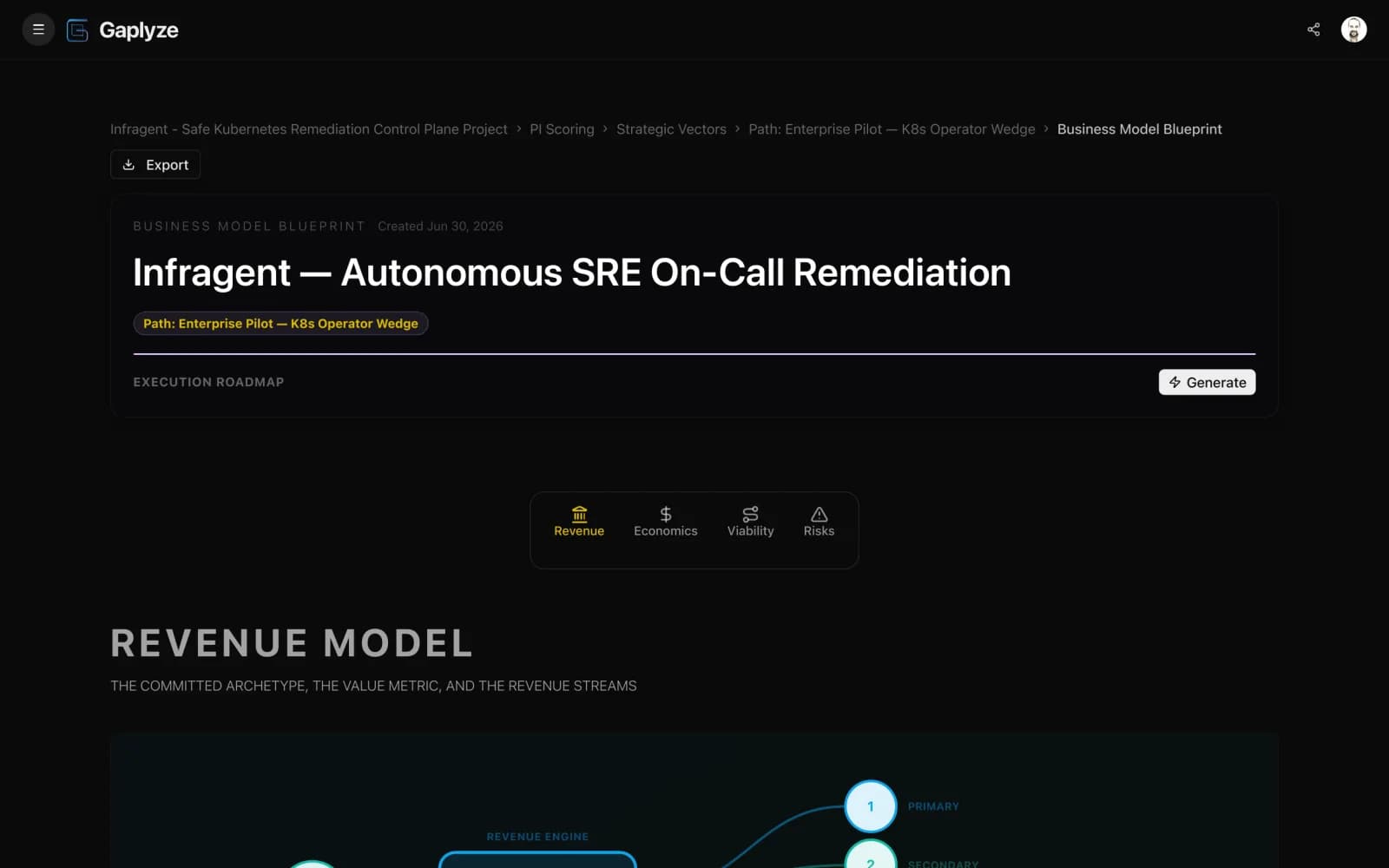
The actual Business Model Blueprint — the revenue architecture, the LTV:CAC and payback numbers, and the layered pricing tiers along one expansion path. Open it and scroll the whole thing.
Roadmap outputs
From a business architecture to the tasks your team executes.
Pre-revenue
- Pricing-thesis interviews with prospect cohort
- Initial tiers drafted + sanity-checked
- Stripe + billing wiring scoped
First revenue
- Charge the first cohort at thesis price
- Track real-world payback vs estimate
- Tighten the tier boundaries from data
Expansion
- Quarterly economics review
- Tier-upgrade triggers + nudges
- Expansion-account playbook
Prompt-pack outputs
Context for your AI agent — from pricing interviews to investor copy.
Pricing-thesis briefing
Foundation customer + value evidence + benchmarks packaged for an AI pricing interviewer
Tier copy pack
Per-tier page copy + comparison table + objection answers ready to paste into your pricing page
Investor narrative
The unit-economics paragraph + LTV defense for the investor-ready export
Sibling blueprints
Where Business Model stops — and where each sibling picks up.
Start free
Score the idea, lock the Foundation, model the business.
No credit card. Generate the architecture, unit economics, and pricing thesis — upgrade for deeper roadmaps, prompt packs, and exports.
FAQ
Business Model questions, answered.
How does the Business Model Blueprint differ from the Monetization Blueprint?
The Business Model Blueprint defines the revenue architecture — who pays, for what, in which motion, with which unit economics. The Monetization Blueprint commits to the specific tier packaging, pricing-ops, and price experimentation against that architecture.
How are the unit economics estimated?
From your Foundation customer + Market Intelligence benchmarks + chosen channel mix. Each input feeds an estimate band (low / base / high) for CAC, LTV, payback, and gross margin — not a single false-precision number.
Can I change the business model mid-build?
Yes. Versioned. When traction or pricing tests reshape the economics, you regenerate the blueprint against the new evidence — the Foundation, GTM, and Monetization blueprints stay in sync.
What do investors expect to see here?
A defensible unit-economics story, a credible expansion path, and a pricing thesis tied to value delivered — not a spreadsheet of made-up numbers. The blueprint produces all three in shape investors recognize.
When should I commit to monetization timing?
The blueprint flags the right monetization trigger — usage threshold, value milestone, time-in-product — based on your Foundation and GTM motion. You don't guess the timing; it's argued from the data.
Can it model multiple revenue streams?
Yes. Each stream (subscription, usage, services, marketplace take, etc.) is authored as its own line in the architecture with its own unit economics, then composed into one combined view.
Continue reading
Where the Business Model goes next.
Stop guessing the price. Argue the economics.
Architecture, unit economics, tiers — the business plan your team and your investors recognize.