
Blueprint Operating System · Product Blueprints
Product blueprints that turn strategy into structure.
Blueprint System·12 deliverables
- Foundation
- Go-to-Market
- Business Model
- Technical
- UX / UI
- Monetization
- AI Agent
- Retention
- Enterprise Buying
- Data Advantage
- Content + Community
- Regulatory + Trust
The job
A strategy doc is a slide. A blueprint is a plan your team can execute on Monday.
Founders write strategy decks and never ship them, because the gap between “here is our positioning” and “here is what eng builds in Q2” is enormous. Blueprints close that gap by slicing the work into discrete decision surfaces with explicit deliverables and dependencies.
You bring
- A scored idea with a chosen strategic path
- Market intelligence already attached to that path
- A team that needs to ship — not just plan
Gaplyze creates
- Path-triggered blueprints — only the ones your motion actually needs
- Structured deliverables per blueprint (no generic frameworks)
- A direct feed into Execution Roadmaps and Prompt Packs
The real surface
Real blueprints, up close.
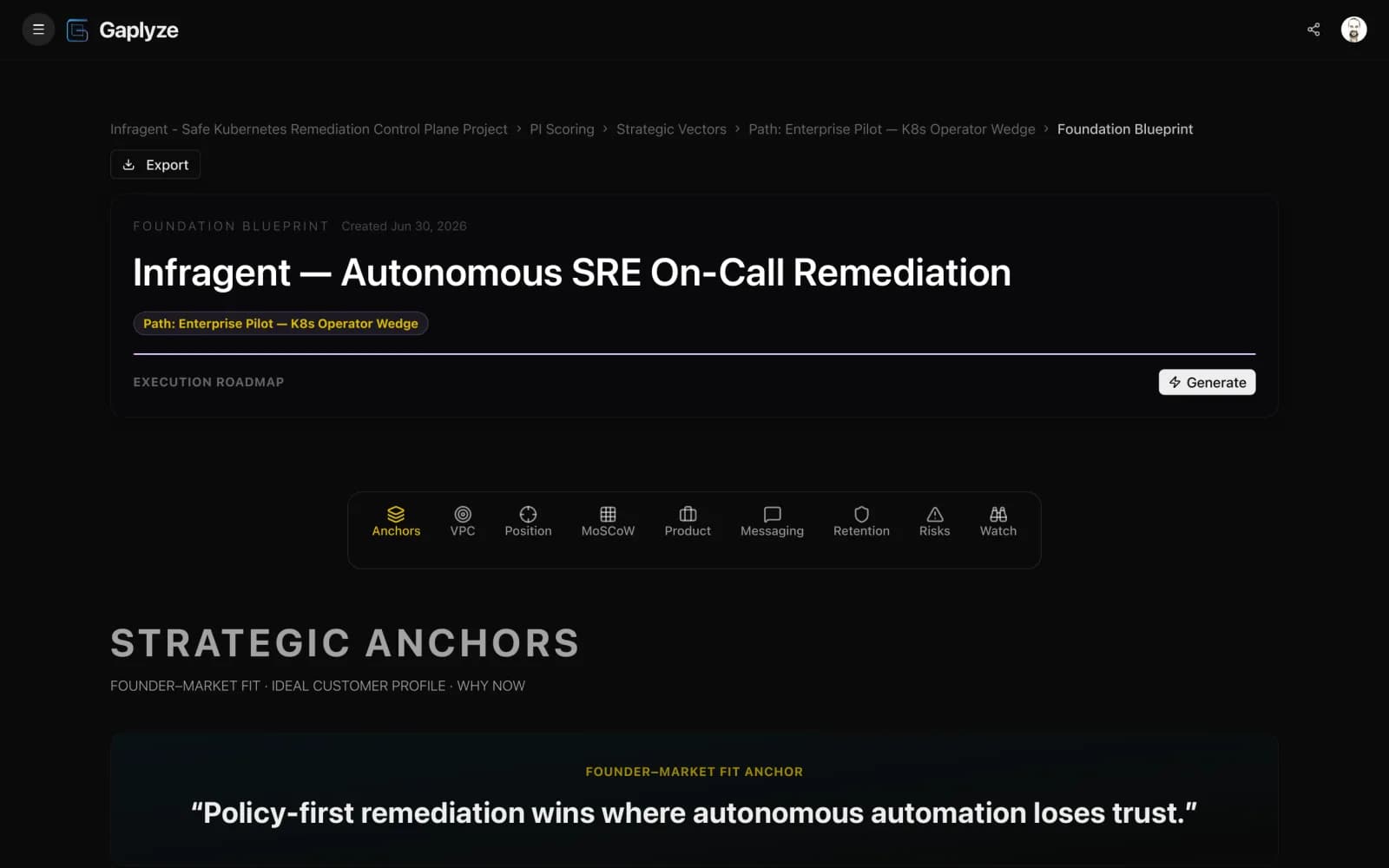
Switch between real generated blueprints — Foundation, Go-to-Market, Business Model, Technical, and the AI Agent blueprint — each with its own framework, deliverables, and definition of done.
Live preview
The Blueprint Operating System.
Each blueprint owns one decision slice of the venture — customer, channel, architecture, retention, monetization, ecosystem — and each one is a route you can open today.
Foundation
Lock the value proposition, positioning, and the wedge worth defending.
UX/UI
Translate the wedge into the experience that actually lands with the buyer.
Technical
Architect the stack the venture will live on for the next few years.
Go-to-Market
Sequence the channels and motions that put the wedge in front of the right buyer.
Content + Community
Build the organic surface that compounds attention into qualified demand.
Monetization
Design the pricing architecture revenue actually flows through.
Business Model
Lock the unit economics the rest of the plan depends on.
Retention
Design the loops that keep activated users coming back without paid acquisition.
Marketplace
Crack the chicken-and-egg and sequence liquidity on both sides.
Enterprise Buying
Map the buying committee and the procurement motion that closes them.
Developer Ecosystem
Earn the developer audience and the platform flywheel underneath it.
Regulatory + Trust
Plan compliance and trust architecture for regulated markets — before they bite.
Data Advantage
Turn data into a compounding moat competitors cannot backfill.
AI Agent
Compose agentic workflows the product depends on without losing the human in the loop.
Not every motion triggers every blueprint — your scored path picks what unlocks.
Inside the Blueprint Operating System
Modular structure. Sibling boundaries. Path-triggered composition.
The Blueprint Operating System is not a unified plan; it is a catalogue of modular blueprints, each owning one decision surface with its own framework, its own deliverables, its own definition of done — anchored to the same scored idea and the same locked strategic path.
One decision surface per blueprint
Each blueprint owns its own decision surface — Foundation owns positioning, GTM owns acquisition, Monetization owns pricing architecture. Sibling boundaries are explicit, so your team always knows where each decision lives.
Modular composition
The catalogue covers the canonical surfaces a venture lives or dies on — Foundation, UX/UI, Technical, Go-to-Market, Business Model, Monetization, Content + Community, Retention, Marketplace, Enterprise Buying, Developer Ecosystem, Regulatory + Trust, Data Advantage, AI Agent. Pick what your motion actually requires; ignore what doesn't apply.
Per-blueprint framework
Each blueprint carries its own reasoning system — Value Proposition Canvas + Jobs-to-Be-Done for Foundation, AARRR Funnel + Bullseye for GTM, Hook Model + Octalysis for Retention. The framework matches the surface.
Definition of done per deliverable
Every blueprint emits a structured set of phased tasks with a definition of done attached. The task is shippable when DoD is met — not when consensus is reached.
Path-triggered generation
Blueprints generate against your locked strategic path — Foundation triggers first; the rest unlock as their prerequisites are met. You don't guess which blueprint matters next; the path tells you.
Roadmap and Prompt Pack handoff
Each blueprint feeds Execution Roadmaps (phase lanes, dependency arrows, DoD per task) and Prompt Packs (the structured brief your AI coding agent builds from). The plan your team ships from is a consequence of the blueprints, not a parallel exercise.
Regeneration with diff preservation
Strategy shifts; blueprints absorb the change without restarting. Regenerating applies the diff — untouched tasks stay put, new tasks slot in, dropped tasks get archived, manual edits are preserved.
Sibling-boundary discipline
Sibling blueprints don't overlap. Foundation owns positioning. GTM owns acquisition. Business Model owns unit economics. Monetization owns pricing tiers. The boundaries remove the most common product-org failure — nobody owning a critical decision because it lives at the seam between adjacent documents.
Investor-Ready Export
The blueprints flow into the defensible memo your team can hand to investors — the same structure, the same evidence, the same conviction. The export is the surface; the blueprints are the substance behind it.
The plan your team ships from is a CONSEQUENCE of the blueprints — not a parallel exercise.
Decision unlocked
You leave with a structured plan per product surface — not a slide deck.
Know which blueprints your motion actually requires — and which to leave for later
Hand each blueprint to the right owner with deliverables already structured
Move into Execution Roadmaps and Prompt Packs without re-writing the plan
Where it fits
The bridge between strategy and delivery.
Strategy Map
Market Intelligence
Blueprints
Execution Roadmaps
Prompt Packs
Strategy Map
Market Intelligence
Blueprints
You are hereExecution Roadmaps
Prompt Packs
Start free
Generate your first blueprint on the free tier.
No credit card. Foundation is included from the first session; sibling blueprints unlock as your motion expands. Upgrade only when the depth of the plan outgrows the free tier.
FAQ
Blueprint questions answered.
What is a blueprint, exactly?
A blueprint is a structured plan for one slice of your product — the customer + positioning slice (Foundation), the acquisition slice (GTM), the architecture slice (Technical), and so on. Each blueprint is generated from your scored idea, your chosen strategic path, and the market intelligence behind that path.
How do blueprints trigger automatically?
Every strategic path you commit to in Strategy Map carries a set of trigger conditions. Foundation triggers first; the rest unlock as their prerequisites are met. You never have to guess which blueprint matters next — the path tells you.
Why a catalogue of blueprints instead of one custom plan?
Each blueprint owns a different decision surface (customer, channel, architecture, retention, governance, monetization, ecosystem) with its own frame and its own deliverable. Bundling them all into a single plan would collapse the structure that lets your team actually execute slice by slice.
How do blueprints feed the roadmap?
Every blueprint emits a structured set of phased tasks with definition-of-done per task. Execution Roadmaps stitches these into phase lanes with dependency arrows — so the roadmap is a consequence of the blueprints, not a separate planning exercise.
Do I need every blueprint to ship?
No. Most early ideas only trigger a handful of blueprints in their first session — Foundation, UX/UI, GTM, and one or two others. The rest unlock as the product surface expands; you can ignore the ones that don't apply to your motion.
Are sibling blueprints overlapping?
No — sibling blueprints intentionally don't overlap. Foundation owns the positioning slice; GTM owns acquisition; Business Model owns unit economics; Monetization owns pricing tiers. The boundaries are explicit so your team knows where each decision lives.
Stop writing strategy decks. Ship the blueprint.
Generate the blueprints your motion actually needs — each one with structured deliverables, dependencies, and a direct feed into your roadmap.