
Monetization Blueprint·12 deliverables
- Pricing Tiers
- Conversion Funnel
- Pricing Ops
- Expansion Ladder
- Tier Matrix
- Willingness to Pay
- Renewal Pipeline
- Churn-Save Offers
- Usage Metering
- Discount Policy
- Packaging Map
- Downstream Feed
When it triggers
Monetization only converts when the wedge is real.
The Monetization Blueprint unlocks after you've scored the idea and picked a strategic path — so tiers, funnel, and pricing ops all map to a real audience and a real willingness to pay.
Step 1
Score the idea
Idea Score sets the commercial premise
Step 2
Pick a strategic path
Strategy Map locks the wedge + audience
Step 3
Generate Monetization Blueprint
This page
Strategic input
The blueprint inherits the work you've already done.
Tiers, conversion funnel, and ops procedures are framed by the same wedge, audience, and market reality that drove your scored idea.
From Strategy Map
- Locked wedge: which job each segment is willing to pay for
- Selected path: how the offering ladders from entry to expansion
- Kill criteria: signals that the monetization motion isn't the right one
From Market Intelligence
- Competitor pricing posture — what segments already pay (and how)
- Willingness-to-pay signals per segment
- Channel-specific pricing norms (PLG vs sales-led)
The real surface
A tier matrix, a funnel, and a pricing-ops register.
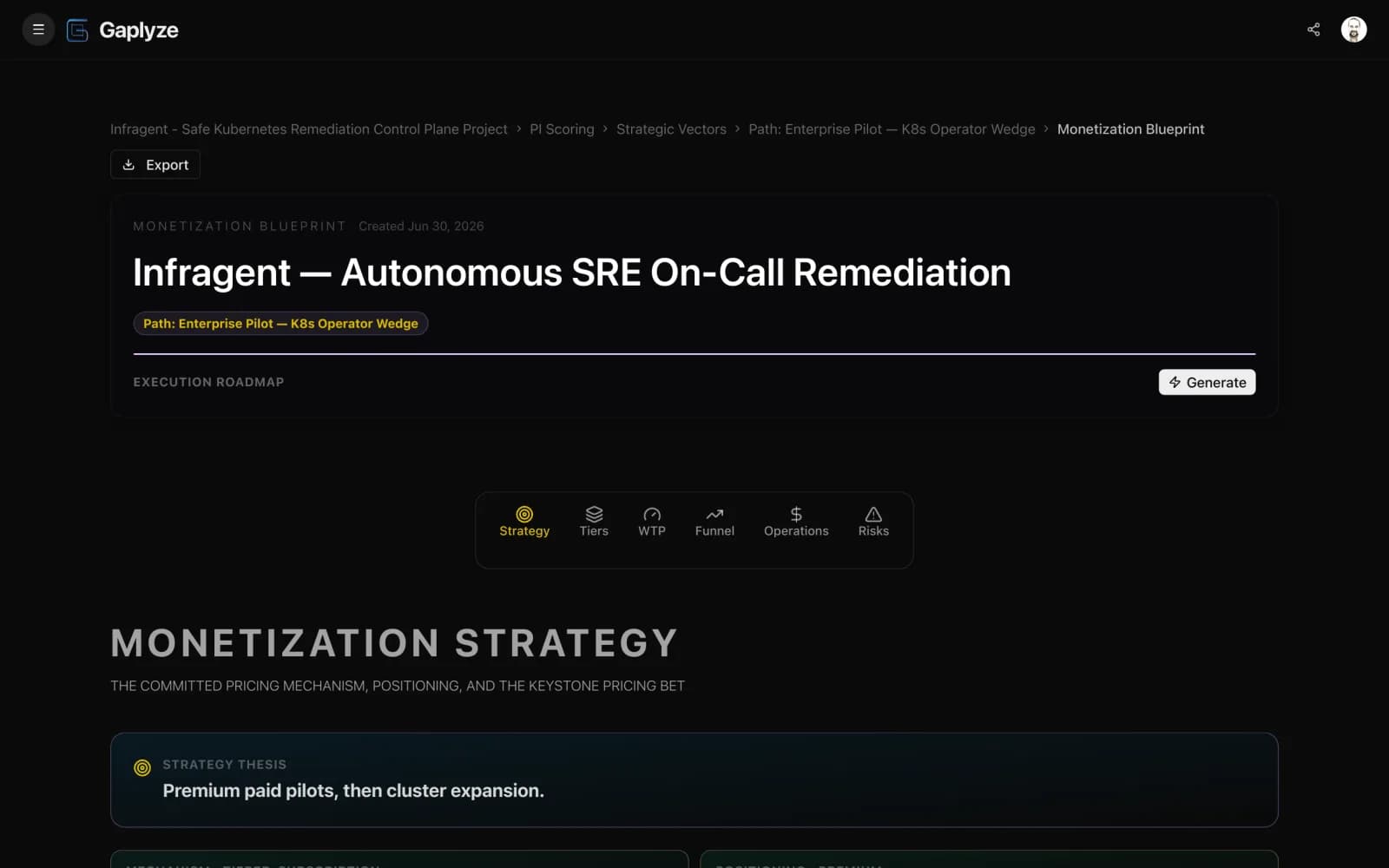
The actual Monetization Blueprint — the tier comparison matrix, the acquisition-to-expansion funnel with conversion %, and the pricing-ops register your finance and product teams operate from. Open it and scroll the whole thing.
Roadmap outputs
From blueprint to delivery plan.
The execution roadmap sequences tiers, funnel work, and pricing-ops into phases — so revenue compounds without billing debt piling up underneath.
Phase 1
Tier + plan launch
Free / paid tiers live · checkout + billing wired
Phase 2
Funnel optimization
Activation moment + upgrade prompts + lifecycle emails
Phase 3
Pricing ops + expansion
Renewal automation + save-offers + multi-product bundling
Prompt-pack outputs
Briefs your AI coding agent can ship.
Every tier and ops procedure becomes a context-rich brief — entitlement model, lifecycle event, save-offer logic — so your AI coding agent ships consistent billing and lifecycle implementations.
Tier brief — feature gating + entitlement schema per tier
Checkout brief — pricing page + plan picker + Stripe integration shape
Activation brief — the first session that earns the upgrade
Renewal brief — auto-renew + notifications + self-serve cancel + save offer
Sibling blueprints
Pairs cleanly with — and stays distinct from — these.
Business Model Blueprint
Revenue architecture and unit economics behind the tiers
Non-overlap: Business Model defines the revenue architecture; Monetization defines the specific tier and funnel.
GTM Blueprint
Channel-specific pricing posture and acquisition
Non-overlap: GTM owns the channel funnel; Monetization owns the pricing + expansion handoffs inside it.
Content and Community Blueprint
Content-tier pricing and community-gated access
Non-overlap: Content + Community feeds the top of funnel; Monetization handles the conversion ladder beneath it.
Retention Blueprint
The lifecycle behavior that earns expansion revenue
Non-overlap: Retention compounds engagement; Monetization captures the resulting willingness to pay.
Included with blueprints
Generate your first Monetization Blueprint.
Start free. Upgrade only when you want the full execution roadmap and prompt pack ready for your AI coding agent.
FAQ
Monetization Blueprint questions answered.
How should I decide on pricing tiers?
Tiers are a function of audience segments + value gating, not gut. The blueprint frames each tier as a job-to-be-done bundle — what each segment will pay for, and which features unlock the next ladder rung.
Usage-based vs seat-based — which is right?
Usage-based aligns price with value when value scales with use (API calls, storage, agents). Seat-based aligns when value is per-person (collaboration tools). The blueprint compares both against your wedge and picks the alignment that converts and expands best.
What's a good discount strategy?
Predictable. Annual prepay (10-20%), multi-year (additional 5-10%), pilot pricing (transparent, time-boxed). Ad-hoc discounting destroys list-price credibility — the Pricing Ops Register puts each discount lever on a documented approval path.
How do I automate renewals?
Auto-renew by default with clear in-product notification 60/30/7 days out, a self-serve cancel path, and a save-offer triggered by predictive churn signals. The Pricing Ops Register tracks the renewal pipeline end to end.
How do I raise prices without losing customers?
Grandfather existing customers for 12 months, communicate the value-added rationale, raise list price first then expand-tier price, and pair the raise with a new tier feature. The blueprint frames each step as a workstream with timing and ownership.
What if I have multiple products?
Each product gets its own monetization shape, but the platform-level expansion path (cross-sell + bundle pricing) lives at the portfolio level. The blueprint handles single-product first and pairs with the Business Model Blueprint for portfolio shape.
Stop guessing on pricing. Plan the conversion.
Generate the Monetization Blueprint built on your scored idea — and run tiers, funnel, and pricing ops from one defensible plan.