
Go-to-Market Blueprint · Acquisition Strategy
Pick the channels, draw the funnel, ship the launch.
Go-to-Market Blueprint·12 deliverables
- Acquisition Funnel
- Channel Matrix
- Content Engine
- Launch Plan
- Audience Priority
- Funnel Rates
- Channel Fit
- CAC Benchmarks
- Messaging
- Experiments
- Compounding Spend
- Downstream Feed
When it triggers
Go-to-Market generates after Foundation locks the wedge.
You need a customer to acquire and a value proposition to lead with — the Foundation gives both. Market Intelligence gives you the channel evidence the plan reads from.
An idea scored on commercial fit
A Foundation Blueprint locking the customer
Market intelligence on competitors and channels
Strategic input
Read from strategy and evidence, not from instinct.
From your Strategy Map
- Selected path with audience prioritization
- Differentiation vectors the launch must signal
- Trade-offs accepted between speed and depth
From Market Intelligence
- Channel-by-channel competitor presence and benchmark CPCs
- Audience density signals across paid, organic, partnerships
- Pricing + offer benchmarks for the chosen segment
The real surface
A funnel, a channel matrix, and a content engine.
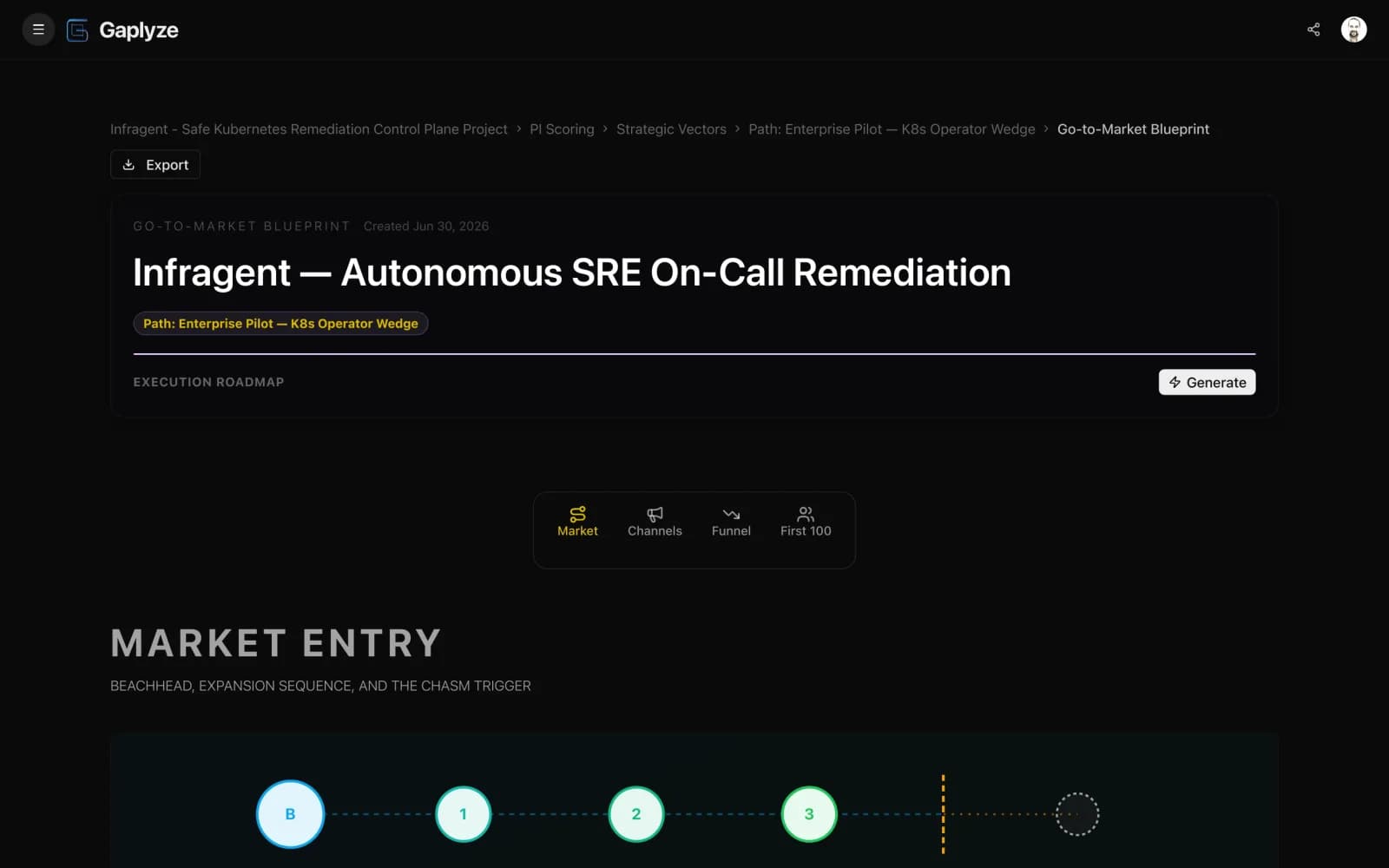
The actual Go-to-Market Blueprint — the acquisition funnel with per-stage rates, the channel matrix with fit verdicts, and the content engine. Open it and scroll the whole thing.
Roadmap outputs
From a launch plan to the tasks your team executes.
Pre-launch
- Pre-warm the top two channels
- Author 6-week content backlog
- Wire conversion tracking + benchmarks
Launch
- Run founder-led outbound to the first 50
- Publish anchor content + community drops
- Track funnel-stage conversion daily
Post-launch
- Quarterly channel-mix audit
- Retire underperforming experiments
- Promote winners to compounding spend
Prompt-pack outputs
Context for your AI agent — from briefing to per-channel detail.
Launch briefing
Funnel, channels, and content backlog packaged as one paste-ready brief for an AI launch agent
Channel-by-channel pack
Per-channel hypothesis, target, and creative starter pack ready to hand to an AI marketing assistant
Outbound script set
Pre-written first-touch outbound copy aligned with the Foundation wedge
Sibling blueprints
Where Go-to-Market stops — and where each sibling picks up.
Foundation Blueprint
Foundation defines the audience. Go-to-Market acquires them at scale.
Business Model Blueprint
Go-to-Market decides which channels to fund. Business Model decides what each acquired customer is worth.
Market Intelligence
Market Intelligence is the evidence layer. Go-to-Market is the plan that commits to the channels.
Content and Community Blueprint
Go-to-Market sets the launch motion. Content and Community runs the always-on engine for distribution and engagement.
Start free
Score the idea, lock the Foundation, generate the launch plan.
No credit card. Generate the funnel + channel matrix + content engine — upgrade for deeper roadmaps, prompt packs, and exports.
FAQ
Go-to-Market questions, answered.
How does the Go-to-Market Blueprint differ from Market Intelligence?
Market Intelligence is the evidence layer — competitor landscape, demand signals, channel benchmarks. The Go-to-Market Blueprint commits to a plan: which audience, which funnel, which channel mix, which content engine. Evidence informs the plan; the plan commits to motion.
How are channels selected?
The blueprint scores candidate channels against your Foundation customer, your evidence from Market Intelligence, and the trade-offs from your Strategy Map. Only channels that match the wedge make the cut — no spray-and-pray.
What funnel benchmarks does it use?
Reference benchmarks per channel + segment (awareness, activation, conversion, retention, expansion). The blueprint flags where your plan sits versus benchmark and where your wedge can earn outsized conversion.
Can I iterate the Go-to-Market mid-launch?
Yes. Channel performance feeds back into the blueprint as evidence; you regenerate the plan against the new data without losing the strategic anchors.
How does the blueprint handle paid vs organic split?
It allocates effort + budget per channel based on the audience density, the buying intent signal, and your runway. The split is explicit, justified, and adjustable.
Does it cover regional plays?
Yes. Regional plays are authored as additional channel and segment branches on the same plan so you can compare global, regional, or focus-market strategies side by side.
Continue reading
Where Go-to-Market goes next.
Stop guessing the launch. Plan the acquisition.
Funnel, channel matrix, content engine — one plan your team ships from.