
How to Optimize Your Startup Strategy
A strategy is a hypothesis, not a monument. This guide shows you how to optimize your startup strategy with evidence — auditing competitors and your own site with Web Insights, fixing your channel mix with Marketing Intelligence, knowing when to pivot, and keeping every artifact fresh as the plan changes.
Table of Contents
How to Optimize Your Startup Strategy: The Short Answer
To optimize your startup strategy, treat it as a living hypothesis you refine against fresh evidence — not a document you write once and defend. The four-part loop is simple: (1) audit reality (your own site and your competitors') with a tool that scores gaps instead of guessing; (2) fix your channel mix based on where demand and creators actually live; (3) decide honestly whether to keep iterating or pivot; and (4) regenerate every downstream artifact — scores, strategy paths, blueprints, roadmaps — so your plan never drifts out of sync with your latest decision.
Most founders get the first 80% right and the last 20% catastrophically wrong. They build a strategy, validate the idea, write a go-to-market plan — and then the world moves, they learn something, they make one change, and the entire plan quietly goes stale. The positioning still references the old segment. The roadmap still front-loads the channel they abandoned. The blueprint still assumes the team they no longer have. Optimization is not about having a smarter initial strategy. It is about closing the gap between what you have learned and what your strategy still says.
The reason this is hard is structural. Static strategy frameworks — the HBR essays, the MIT Sloan case studies, the McKinsey 2x2s — are excellent at teaching you how to think the first time. But they cannot audit your specific website, score your specific competitor's gaps, or rewrite your specific roadmap when you change one variable. That is the difference between a framework and a tool: a framework gives you a mental model; a tool that audits your site and regenerates the plan gives you a refreshed strategy on demand. This guide is about the second thing.
An HBR essay on competitive strategy is timeless and generic. It will never look at YOUR landing page, YOUR competitor's pricing tier, or YOUR stale roadmap. Optimization requires something a static essay structurally cannot do — re-examine your actual artifacts and rewrite them when the inputs change. That is the entire value of an evidence-based strategy tool: it audits what you have, and it regenerates what no longer fits.
Why Strategy Is Iterative, Not a One-Time Document
A startup strategy is a bet about an uncertain future. Every bet has odds, and the odds change the moment new information arrives — a competitor ships a feature, a channel gets saturated, a segment turns out to be smaller than you thought, your runway shortens. A strategy written in month one and never revisited is, by month six, a bet placed on a board that no longer exists.
This is why the founders who win are not the ones with the most brilliant opening strategy — they are the ones who update fastest. They treat strategy as a loop: form a hypothesis, ship against it, gather evidence, refine. Each cycle is cheaper and faster than the last because the structure is already built. What slows most founders down is not the thinking; it is the labor of rewriting everything downstream every time the thinking changes.
That labor is exactly what an integrated workspace eliminates. When your idea score, your strategic paths, your blueprints, and your execution roadmap all share the same underlying context — the same project framing, the same competitive landscape, the same positioning — then changing one input can cascade through all of them automatically. You make the decision; the system refreshes the artifacts. The loop stops being a chore and becomes a habit.
Evidence-Based Refinement: Audit Competitors and Your Own Site
You cannot optimize what you have not measured, and most strategy refinement fails because it is based on opinion rather than evidence. The fix is to start every optimization cycle with an audit — a structured, scored look at two things: what your competitors are actually doing, and what your own site or strategy actually communicates today.
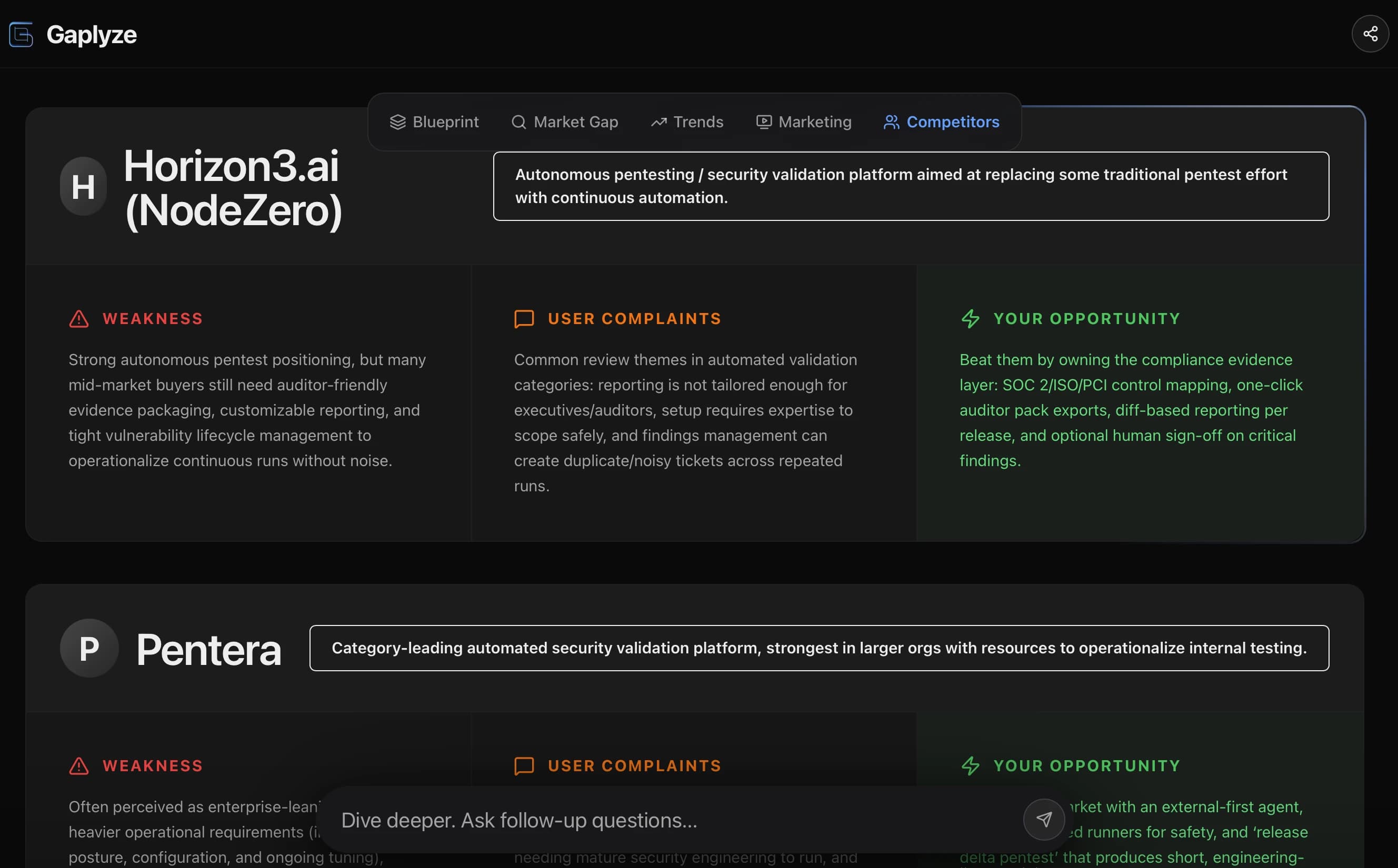
Gaplyze does this with Web Insights. You give it a URL — a competitor's site, or your own — and it turns that page into a scored opportunity report with specific, impact-estimated recommendations. Instead of a vague sense that 'their messaging is sharper,' you get a concrete read on where the gaps are: positioning that is unclear, value propositions that are buried, segments that are underserved, features that are over- or under-emphasized. Because it scores on the same unified, dimension-aware framework used across the rest of the platform, a 75 on one audit means the same thing as a 75 on another — you can compare a competitor's site against your own on identical terms.
The discipline here is to audit both sides. Run Web Insights on the two or three competitors who keep beating you to a segment, and you will see the strategic moves they are making that you can answer. Run it on your own site, and you will see the gap between the strategy you think you are executing and the one a visitor actually perceives. Optimization lives in that gap. The recommendations are impact-estimated, so you can sequence the highest-leverage fixes first instead of polishing things no one will notice.
Turn a URL into a scored strategy audit
Point Web Insights at a competitor's site — or your own — and get a scored opportunity report with specific, impact-estimated recommendations you can act on this week.
Channel-Mix Optimization with Marketing Intelligence
The single most common strategic leak in early-stage companies is a misallocated channel mix — pouring effort into acquisition channels that look productive but cannot scale, while ignoring the one or two where your specific audience actually congregates. Optimizing your go-to-market is, in large part, the discipline of finding and doubling down on the channels that fit your motion and abandoning the ones that do not.
Gaplyze's Marketing Intelligence ranks 10+ acquisition channels against your specific business, synthesizing demand signals and surfacing the creators and communities where your audience already pays attention. Instead of spreading thin across every channel a generic GTM guide recommends, you get a ranked channel matrix tailored to your positioning — so you can concentrate scarce time and budget on the handful of channels with the strongest fit.
Channel optimization is iterative by nature. The channel that wins at launch is rarely the channel that scales, and the mix that fits a bootstrapped solo founder is rarely the one that fits a funded team. Because Marketing Intelligence reads from the same project framing as the rest of your workspace — your stage, your budget, your team reality — its rankings reflect your actual constraints, not a one-size-fits-all template. Re-run it when your situation changes, and the recommended mix shifts with you.
“A static essay can tell you that channel-mix matters. Only a tool that reads your actual framing can tell you which channels fit YOUR stage, YOUR budget, and YOUR audience — and re-rank them when those change.”
When and How to Pivot
Pivoting is the most consequential — and most emotionally fraught — strategic decision a founder makes. The danger runs in both directions: pivot too early and you abandon a strategy that simply needed more time; pivot too late and you burn the runway you needed to make the pivot work. The way out of this trap is to make the decision against evidence rather than mood.
Start by separating the layers. A pivot is not one thing — you can change your segment while keeping the product, change the product while keeping the segment, change your business model, your channel, or your positioning. Most 'should I pivot' agonizing is really a failure to ask which specific layer the evidence is pointing at. Run your strategy and your competitors through an audit, look at the scored gaps, and the evidence usually indicts one layer, not all of them. Changing that one layer is a refinement; changing all of them at once is a restart.
The honest signals that justify a pivot are concrete: demand evidence that stays flat no matter how you sharpen the message; a competitive landscape that closes the whitespace you were aiming at; a channel mix where every viable channel has been tried and none can reach your audience efficiently; killer assumptions that have been tested and have failed. When the evidence is ambiguous, the right move is usually to keep refining — to run another optimization loop — rather than to leap. A pivot is a strategy decision, and a strategy decision deserves the same evidence-based scrutiny as the original bet.
The most expensive pivots are the ones made on a bad week rather than bad data. Before you change direction, audit what you actually have: re-score the idea against the eight dimensions, re-run the competitive landscape, and look at the evidence ledger. If the evidence indicts one specific layer — segment, channel, model, or positioning — change that layer. If it indicts everything, you may be looking at a restart, not a pivot. If it indicts nothing, you have a messaging problem, not a strategy problem.
The Optimization Loop: Five Steps to Refine Your Strategy
Audit reality with Web Insights
Run Web Insights on your own site and your two or three sharpest competitors. You get scored opportunity reports with impact-estimated recommendations — a concrete, comparable read on where the strategic gaps are, instead of an opinion about who has 'better messaging.'
Re-rank your channel mix with Marketing Intelligence
Re-run Marketing Intelligence against your current framing to get an updated ranked matrix of 10+ acquisition channels. Concentrate on the handful with the strongest fit for your stage and audience; stop spreading thin across channels that cannot scale for you.
Decide: refine or pivot
Use the audit evidence to identify which single layer the data indicts — segment, product, model, channel, or positioning. Changing one layer is a refinement; changing all of them is a restart. When the evidence is ambiguous, run another loop instead of leaping.
Regenerate the downstream artifacts
Once you make a change, regenerate the affected artifacts — idea score, strategic paths, blueprints, roadmaps — so nothing references the strategy you just left behind. Gaplyze's staleness tracking flags exactly which artifacts have drifted, so you refresh only what changed.
Re-validate the new bet
Treat the refined strategy as a fresh hypothesis. Re-score it, check the killer assumptions, and ship against it. Each cycle is cheaper than the last because the structure already exists — optimization becomes a fast, repeatable habit rather than a rewrite.
Keeping Your Artifacts Fresh: Regeneration and Staleness Tracking
Here is the failure mode that quietly kills more strategies than any single bad decision: drift. You change one input — you sharpen your positioning, you switch your lead channel, you narrow your segment — and you update the one document in front of you. But the idea score still reflects the old positioning. The execution roadmap still front-loads the abandoned channel. The Foundation blueprint still assumes the original segment. Each artifact is individually plausible and collectively contradictory. Your strategy is now a set of documents that no longer agree with each other.
Gaplyze solves drift with regeneration and staleness tracking. When you change a strategic input, the platform flags which downstream artifacts have gone stale — which scores, strategy paths, blueprints, and roadmaps now reference a reality you have moved past. You are not left guessing what needs updating, and you are not forced to rewrite everything by hand. You regenerate exactly the artifacts that drifted, and they come back aligned to your latest decision, threaded through the same project framing as everything else.
This is the mechanism that makes the optimization loop sustainable. Without it, the cost of refining your strategy grows with every change, because each change means manually reconciling a sprawling set of documents — and so founders stop refining. With staleness tracking and one-action regeneration, the cost of keeping your strategy current stays flat no matter how many times you iterate. That is what turns 'optimization' from an aspiration into something you actually do every week.
Frameworks vs. a Tool That Audits and Regenerates
There is no shortage of strategy wisdom on the internet. The HBR archives, the MIT Sloan case library, the a16z essays, the McKinsey playbooks — these are genuinely excellent, and you should read them. They will sharpen how you think about positioning, defensibility, and timing. But notice what they cannot do: they cannot open your website and score it, they cannot look at your competitor's pricing page and quantify the gap, and they cannot rewrite your stale roadmap when you change your segment. A static essay is a mirror that only ever shows you the author's reasoning — never your own artifacts.
That is the honest line between a framework and Gaplyze. A framework teaches you the move; Gaplyze runs the move against your real inputs and refreshes the output. Web Insights audits an actual URL into a scored report. Marketing Intelligence ranks actual channels against your actual framing. Regeneration rewrites your actual artifacts when your actual strategy changes. None of these replaces the wisdom in a great strategy essay — they operationalize it on your specific company, on demand, as many times as you iterate.
So the optimization workflow is not 'read more essays.' It is: read the frameworks once to build the mental model, then run an evidence-based loop on your own company — audit, re-rank, decide, regenerate, re-validate — every time the world changes the odds of your bet. Frameworks make you smart once. A tool that audits and regenerates keeps your strategy current for as long as you are running the company.
Written by
Eli AbdeenFounder of Gaplyze — the product-intelligence OS that turns raw ideas into investor-ready product bets. More about the team →
Keep Exploring
Stop letting your strategy go stale.
Audit your site and your competitors with Web Insights, re-rank your channel mix with Marketing Intelligence, and regenerate every artifact the moment your plan changes — so your strategy is always current, always evidence-based, and always your own.
Frequently Asked Questions
How often should I optimize or refine my startup strategy?+
Optimize whenever the evidence behind your bet changes — a competitor ships, a channel saturates, a segment proves smaller than expected, or a killer assumption gets tested. In practice, an early-stage founder benefits from a light optimization loop every few weeks: a quick Web Insights audit of yourself and a key competitor, a re-rank of your channel mix, and a regeneration of any artifacts that have gone stale. The point is not to thrash; it is to keep the gap between what you have learned and what your strategy says as small as possible.
What's the difference between optimizing a strategy and pivoting?+
Optimization refines one layer of your strategy while keeping the rest intact — sharpening your positioning, switching your lead channel, or narrowing your segment based on evidence. A pivot changes the core bet itself. The practical test: run an audit and see which single layer the data indicts. If the evidence points at one layer, change that layer — that's optimization. If it indicts every layer at once, you may be looking at a restart, not a pivot. Most 'should I pivot' agonizing is really a refinement question in disguise.
How do I know which marketing channels to focus on?+
Don't spread thin across every channel a generic go-to-market guide lists. Use Marketing Intelligence to rank 10+ acquisition channels against your specific business — it synthesizes demand signals and surfaces the creators and communities where your audience already pays attention, weighted by your stage, budget, and team reality. Concentrate on the handful with the strongest fit, and re-run the ranking when your situation changes, because the channel that wins at launch is rarely the one that scales.
Why do strategy documents go stale, and how do I keep them current?+
They go stale because of drift: you change one input — positioning, channel, segment — and update only the document in front of you, leaving your idea score, blueprints, and roadmap referencing a reality you've moved past. Each artifact stays individually plausible but collectively contradictory. Gaplyze's staleness tracking flags exactly which downstream artifacts have drifted when you change a strategic input, and one-action regeneration rewrites only those — so the cost of keeping your strategy current stays flat no matter how many times you iterate.
Why use a tool to optimize strategy instead of reading HBR or MIT Sloan essays?+
Read the essays — they're excellent at teaching you how to think about positioning, defensibility, and timing. But a static essay structurally cannot audit your specific website, score your specific competitor's gaps, or rewrite your specific stale roadmap. A framework teaches the move once; a tool runs the move against your real inputs and refreshes the output on demand. Gaplyze operationalizes strategy wisdom on your specific company: Web Insights audits an actual URL into a scored report, Marketing Intelligence ranks actual channels against your actual framing, and regeneration rewrites your actual artifacts when your strategy changes.