
AI Agent Blueprint·12 deliverables
- Capability Matrix
- Orchestration Plan
- Safety + HITL
- Eval Governance
- Autonomy Frame
- Agent Positioning
- Golden Examples
- Adversarial Probes
- Audit Log
- Handoffs
- Guardrails
- Downstream Feed
When it triggers
Agent strategy only matters once the wedge is agentic-shaped.
The AI Agent Blueprint unlocks after you've scored the idea and picked a strategic path — so capability scope, safety boundaries, and eval governance all map to a real wedge and a real audience.
Step 1
Score the idea
Idea Score sets the commercial premise
Step 2
Pick a strategic path
Strategy Map locks the wedge + audience
Step 3
Generate AI Agent Blueprint
This page
Strategic input
The blueprint inherits the work you've already done.
Capability scope, safety boundaries, and eval governance are framed by the same audience and market reality that drove your scored idea.
From Strategy Map
- Locked wedge: which job the agent actually needs to do
- Selected path: how much autonomy the customer wants the agent to have
- Kill criteria: signals the agentic motion isn't the right one
From Market Intelligence
- Competitor agent posture — what users already expect (or resist)
- Regulatory signals — EU AI Act category fit, sector-specific rules
- Trust signals — where users want HITL vs full automation
The real surface
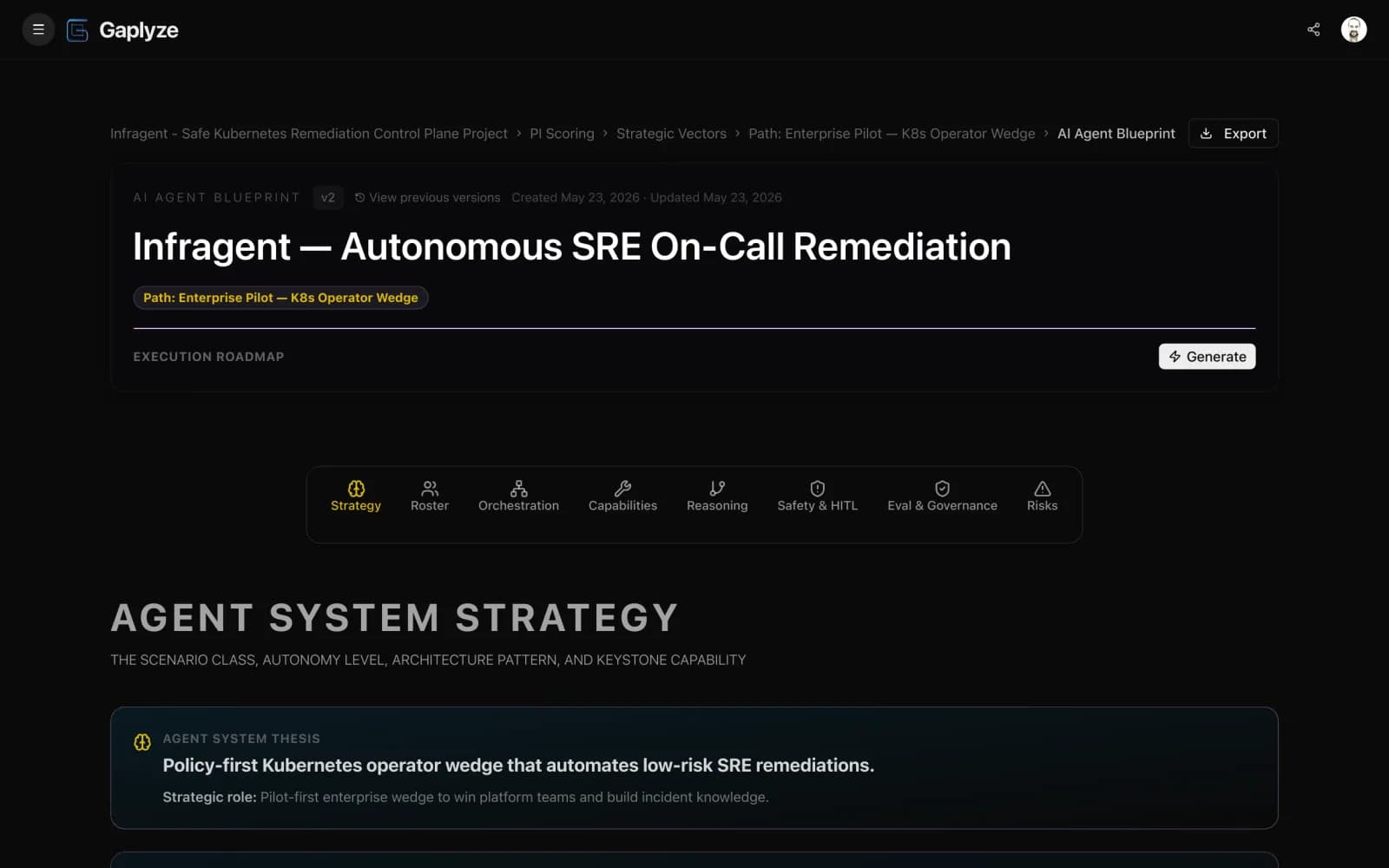
A capability matrix, an orchestration plan, and a safety register.
The actual AI Agent Blueprint — the capability matrix, the orchestration tables, the safety + HITL register, and the eval-governance program every shipping agent needs. Open it and scroll the whole thing.
Roadmap outputs
From blueprint to delivery plan.
The execution roadmap sequences capabilities, safety gates, and eval coverage into phases — so the agent earns trust before it earns autonomy.
Phase 1
Read-only agent
Knowledge-base search + grounded responses + citation eval
Phase 2
Action-taking agent
Per-capability HITL gates + audit log + regression suite
Phase 3
Multi-agent orchestration
Specialist agents + handoffs + shared memory
Prompt-pack outputs
Briefs your AI coding agent can ship.
Every capability and gate becomes a context-rich brief — scope, boundary, eval criteria — so your AI coding agent ships consistent agent surfaces and safety controls.
Capability brief — scope + boundary + HITL + eval criteria per capability
Tool brief — interface contract + error model + side-effect classification
Eval brief — test-case structure + adversarial probe library + scoring rubric
Safety brief — HITL gates + escalation paths + incident response
Sibling blueprints
Pairs cleanly with — and stays distinct from — these.
Technical Blueprint
Serving stack + tool implementations the agent calls (bidirectional)
Non-overlap: Technical owns serving + tool runtime; AI Agent owns the agent spec that uses them.
UX/UI Blueprint
The conversational surface the agent appears inside
Non-overlap: UX/UI ships the surface; AI Agent defines what the agent does inside it.
Data Advantage Blueprint
The dataset and signal the agent feeds on
Non-overlap: Data Advantage governs the data; AI Agent decides how the agent uses it.
Regulatory and Trust Blueprint
Surrounding AI-governance program (EU AI Act / NIST AI RMF)
Non-overlap: Regulatory + Trust runs the program; AI Agent owns the agent-level governance inside it.
Included with blueprints
Generate your first AI Agent Blueprint.
Start free. Upgrade only when you want the full execution roadmap and prompt pack ready for your AI coding agent.
FAQ
AI Agent Blueprint questions answered.
What's the difference between an AI agent and a chatbot?
A chatbot replies. An agent plans, takes actions, observes outcomes, and reflects — often across multiple tools and turns. The Agent Capability Matrix frames whether your wedge actually needs agentic behavior or whether a deterministic flow would serve users better.
How do safety boundaries get designed?
By capability rather than by prompt. The Capability Matrix lists what the agent can do, what scope it operates in, when a human is required, and which evaluations gate each capability. Boundaries live in the spec, not in fragile prompt strings.
When does human-in-the-loop (HITL) matter?
Whenever the cost of a wrong action exceeds the cost of a delay — irreversible operations, financial transactions, customer-facing communications, regulated decisions. The HITL Register tracks each capability's gate, latency budget, and escalation path.
What does an eval framework look like?
A standing set of test cases — golden examples, adversarial probes, regression suites — that the agent must pass before each deploy. The Eval Governance Register tracks owner, cadence, and pass-rate target per eval suite.
Can I orchestrate multiple agents?
Yes — the State Machine handles single-agent loops; for multi-agent, the Orchestration Tables define which agent owns which task, how handoffs happen, and how shared memory works. The blueprint frames whether multi-agent is necessary or if a single agent with sub-tools is simpler.
How do regulatory frameworks apply to AI agents?
EU AI Act categories, NIST AI RMF, sector-specific rules (FDA / FINRA / etc.) all add obligations beyond data privacy. The blueprint maps which apply and pairs with the Regulatory and Trust Blueprint for the surrounding compliance program.
Ship an agent with boundaries in the spec — not in a prompt.
Generate the AI Agent Blueprint built on your scored idea — and run capability, safety, and eval governance from one defensible plan.