
Data Advantage Blueprint·12 deliverables
- Data Sources
- Privacy Register
- Data Products
- Ingest Pipeline
- Consent Model
- Retention Policy
- Positioning Frame
- Data Moat
- Dedupe
- Minimization
- Governance
- Downstream Feed
When it triggers
Data strategy only compounds when the wedge is data-shaped.
The Data Advantage Blueprint unlocks after you've scored the idea and picked a strategic path — so sources, privacy, and the data-product roadmap all map to a known wedge and a known audience.
Step 1
Score the idea
Idea Score sets the commercial premise
Step 2
Pick a strategic path
Strategy Map locks the wedge + audience
Step 3
Generate Data Advantage Blueprint
This page
Strategic input
The blueprint inherits the work you've already done.
Sources, privacy posture, and the data-product roadmap are framed by the same wedge and audience that drove your scored idea.
From Strategy Map
- Locked wedge: where compounding signal beats raw features
- Selected path: which data the wedge actually needs (and which is noise)
- Kill criteria: signals the data motion isn't the right one
From Market Intelligence
- Competitor data posture — which datasets are commodity vs scarce
- Public-data availability + licensing constraints in your space
- Demand evidence per dataset and per derived product
The real surface
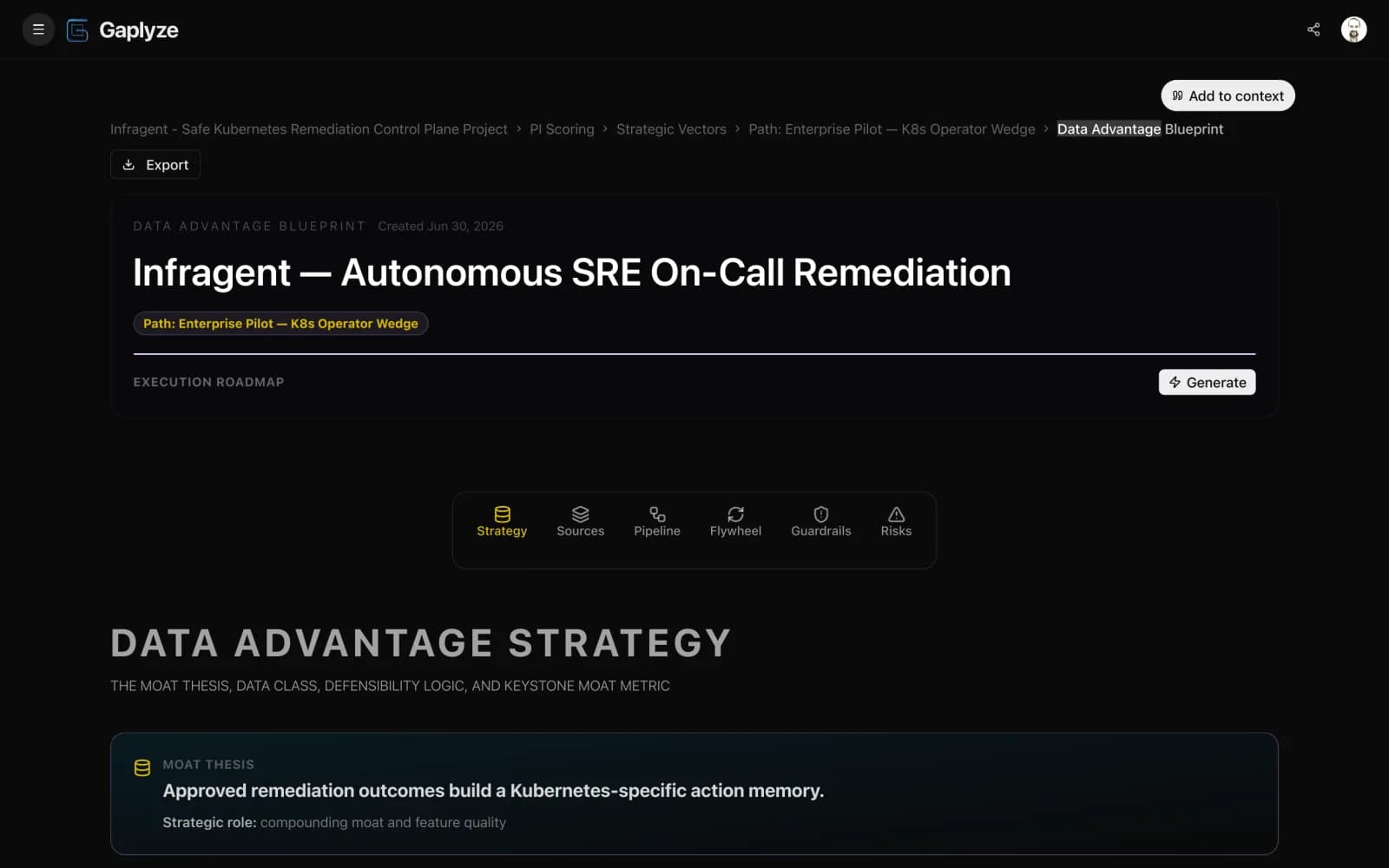
A positioning frame, a sources map, and a privacy register.
The actual Data Advantage Blueprint — the data-advantage positioning frame, the sources map, and the privacy-ethics register your team can defend to customers and regulators alike. Open it and scroll the whole thing.
Roadmap outputs
From blueprint to delivery plan.
The execution roadmap sequences ingest, governance, and data products into phases — so the moat compounds without privacy debt piling up underneath.
Phase 1
Source + ingest
First-party schema + ingest pipeline + dedupe
Phase 2
Privacy + governance
Privacy ethics register live + consent UX + retention pipeline
Phase 3
Data products
Derived datasets + partner exchanges + research APIs
Prompt-pack outputs
Briefs your AI coding agent can ship.
Every dataset and pipeline becomes a context-rich brief — schema, consent model, freshness SLA — so your AI coding agent ships consistent ingest and privacy implementations.
Schema brief — event shapes + dimensions + dedupe keys
Ingest pipeline brief — batch vs stream + idempotency + retries
Privacy controls brief — consent UX + retention pipeline + deletion API
Data-product brief — derived dataset + access pattern + freshness SLA
Sibling blueprints
Pairs cleanly with — and stays distinct from — these.
Technical Blueprint
Data platform implementation — warehouse / lake / streams
Non-overlap: Technical builds the data platform; Data Advantage defines what flows through it and why.
Regulatory and Trust Blueprint
Broader privacy and compliance program
Non-overlap: Regulatory + Trust runs the program; Data Advantage governs the dataset and source posture.
AI Agent Blueprint
The agent that feeds on the dataset
Non-overlap: AI Agent consumes the dataset; Data Advantage shapes what's in the dataset to begin with.
Business Model Blueprint
Monetization of derived data products
Non-overlap: Business Model decides how data products are priced; Data Advantage decides which to build.
Included with blueprints
Generate your first Data Advantage Blueprint.
Start free. Upgrade only when you want the full execution roadmap and prompt pack ready for your AI coding agent.
FAQ
Data Advantage Blueprint questions answered.
How does a data moat differ from a feature moat?
Feature moats erode the moment a competitor ships the same feature. Data moats compound — every customer interaction makes the next prediction or recommendation better. The blueprint frames whether your wedge is data-shaped or feature-shaped before you commit to the investment.
Is proprietary data always better than public data?
No. Proprietary data is harder to acquire but defensible; public data is abundant but commoditized. The Data Sources Map plots both, so you can see which mix actually creates compounding advantage in your category.
When does synthetic data make sense?
When real data is scarce, sensitive, or biased. The blueprint frames synthetic data as a complement — useful for bootstrapping, fine-tuning, and rare-event simulation — never as a replacement for the long-tail signal real users produce.
Should I share data with partners?
Only if the exchange compounds asymmetrically in your favor. The Privacy Ethics Register includes a partner-data clause — what you share, what you receive, and how you guard against re-identification.
What does privacy by design actually look like?
Minimization (collect only what you need), purpose-limitation (use it only for the stated job), consent UX, and deletion as a first-class operation. The Privacy Ethics Register tracks each as a row with owner, evidence, and audit cadence.
Are there regulatory considerations specific to data products?
Yes — GDPR purpose-limitation, CCPA opt-out, sector rules (HIPAA / FERPA / GLBA), and the EU Data Act for B2B data sharing. The Regulatory and Trust Blueprint sits alongside this one to handle the broader program.
Build a data moat that compounds — without the privacy debt.
Generate the Data Advantage Blueprint built on your scored idea — and run sources, governance, and data products with one defensible plan.