
How to Validate a Startup Idea (Honestly)
A transparent, evidence-first method to validate a startup idea — talk to real users, read demand signals, score the opportunity across eight dimensions, and read the verdict like a skeptic. No two-second yes. Show the work.
Table of Contents
How to Validate a Startup Idea Without Fooling Yourself
Here is the honest answer first. To validate a startup idea, you confirm three things with evidence — not opinion: a specific group of people has a painful, recurring problem; they are already spending time, money, or effort trying to solve it; and your approach is meaningfully better than what they use today. Everything else is decoration. You reach that evidence by talking to real prospective users, reading independent demand signals across multiple sources, and scoring the opportunity on the dimensions that actually predict whether a business survives. If those three things hold up under pressure, you have a validated idea. If they do not, you have a hypothesis — and the cheapest place to discover that is here, before you build.
The trouble is that the loudest tools in this category do the opposite of evidence. A wave of AI validators promise a verdict in two seconds: paste a sentence, get a confident score and a tidy report. Try the experiment yourself — feed a deliberately terrible idea into one of them. Most still find something encouraging to say. A tool that says yes to everything is not a validator; it is a flattery machine, and flattery is the single most expensive thing a founder can buy. The reason these tools feel good is the reason they fail you: they hide their reasoning, cite no sources, and never tell you what they could not verify.
This guide takes the opposite stance. Real validation shows its work. Every claim should be traceable to where it came from, every score should explain why it landed where it did, and the gaps — the things nobody can confirm yet — should be named out loud rather than papered over. That principle, transparency over confidence theatre, runs through everything below and through how Gaplyze is built.
If a validator returns a polished score without showing which demand signals it read, which competitors it found, and what it could not verify, you have not validated anything — you have outsourced your optimism. The test of a real validator is not how fast it says yes. It is whether it can show you why, and whether it is willing to say what it does not know.
What Validation Actually Proves (and What It Doesn't)
Validation is widely misunderstood as proving your idea is good. It is not. It is reducing the most expensive uncertainty before you spend the most expensive resource — months of your life. You are not chasing certainty; you are crossing a conviction threshold, the point where the evidence is strong enough to justify the next commitment and no stronger. Over-validating a tiny decision wastes the same time you are trying to protect.
There is a crucial distinction between desirability and the rest. Validation primarily proves desirability — that people genuinely want the outcome and feel the pain. It can gather early evidence on viability (will they pay enough, often enough?) and feasibility (can a small team build it?), but those are tested most honestly later, in the market. Confusing the three is how founders 'validate' a beautiful demo nobody will buy.
Equally important is what validation cannot do. It cannot prove a future. The most rigorous evidence today tells you the problem is real and the timing looks right; it does not guarantee execution, channel, or pricing. So the goal is not a green light that removes all doubt. The goal is an honest map of what you know, what you have inferred, and what remains unproven — so you decide with your eyes open instead of your hopes up.
Talk to Real Users First: The Mom Test
No demand signal, score, or report substitutes for conversations with the people you intend to serve. The discipline here is Rob Fitzpatrick's Mom Test: ask questions even your mother could not lie to you about. That means you never pitch your idea and never ask 'would you use this?' — people are kind, and a hypothetical yes is worthless. Instead you ask about their life as it already is.
Anchor every conversation in the past, not the future. Ask what they did the last time the problem bit them, how much time or money it cost, what they tried, and why those attempts failed. 'Would you pay for this?' invites a polite lie; 'what are you currently paying to deal with this?' surfaces a fact. The strongest signal is a workaround — a spreadsheet they maintain by hand, a freelancer they hire, a process they hate but repeat — because a workaround is demand that has already opened its wallet.
Aim for ten to fifteen of these before you trust any pattern, and listen for emotion and specificity rather than approval. When you hear the same painful story repeated by strangers who have no reason to flatter you, you have the only kind of validation that money cannot fake. Gaplyze does not replace this step — nothing should. What it does is sharpen it: by mapping who the underserved segment is and what the competitive whitespace looks like, it tells you who to interview and which assumptions to pressure-test before you pick up the phone.
Reading Demand Signals Across Multiple Sources
Conversations tell you the problem is real for a few people. Demand signals tell you whether it is real at scale — and whether the timing is moving toward you or away. The danger is single-source validation. Read only Google Trends and you may chase a seasonal spike; read only one subreddit and you may build for a vocal minority; study only competitors and you may inherit someone else's mistake. Each source narrates a fragment.
The reliable move is convergence: corroborating a problem across independent sources that have no reason to agree. Rising problem-oriented search queries indicate growing, unmet awareness. Recurring complaints and homemade workarounds in community discussions reveal pain intense enough to act on. Recent launches with traction prove a category is fundable; conspicuous gaps in launch activity hint at openings. Capital flowing into the space signals institutional belief — though a market flooded with well-funded entrants is harder to crack than one with moderate momentum.
Gaplyze automates this convergence rather than asking you to trust a single number. Its idea generation and market intelligence read signals across sources including Google Trends, Reddit, Product Hunt, Hacker News, venture funding activity, the G2 and Capterra review landscape, X, and GitHub, then synthesize where they agree and where they contradict. Critically, the output is not a verdict you must take on faith — it is an evidence trail you can inspect, which is the whole point of validating honestly.
“A confident score with no sources is a guess in a suit. Convergence across independent signals — search, community, launches, capital — is the difference between hope and evidence.”
The 8 Dimensions of a Real Idea Score
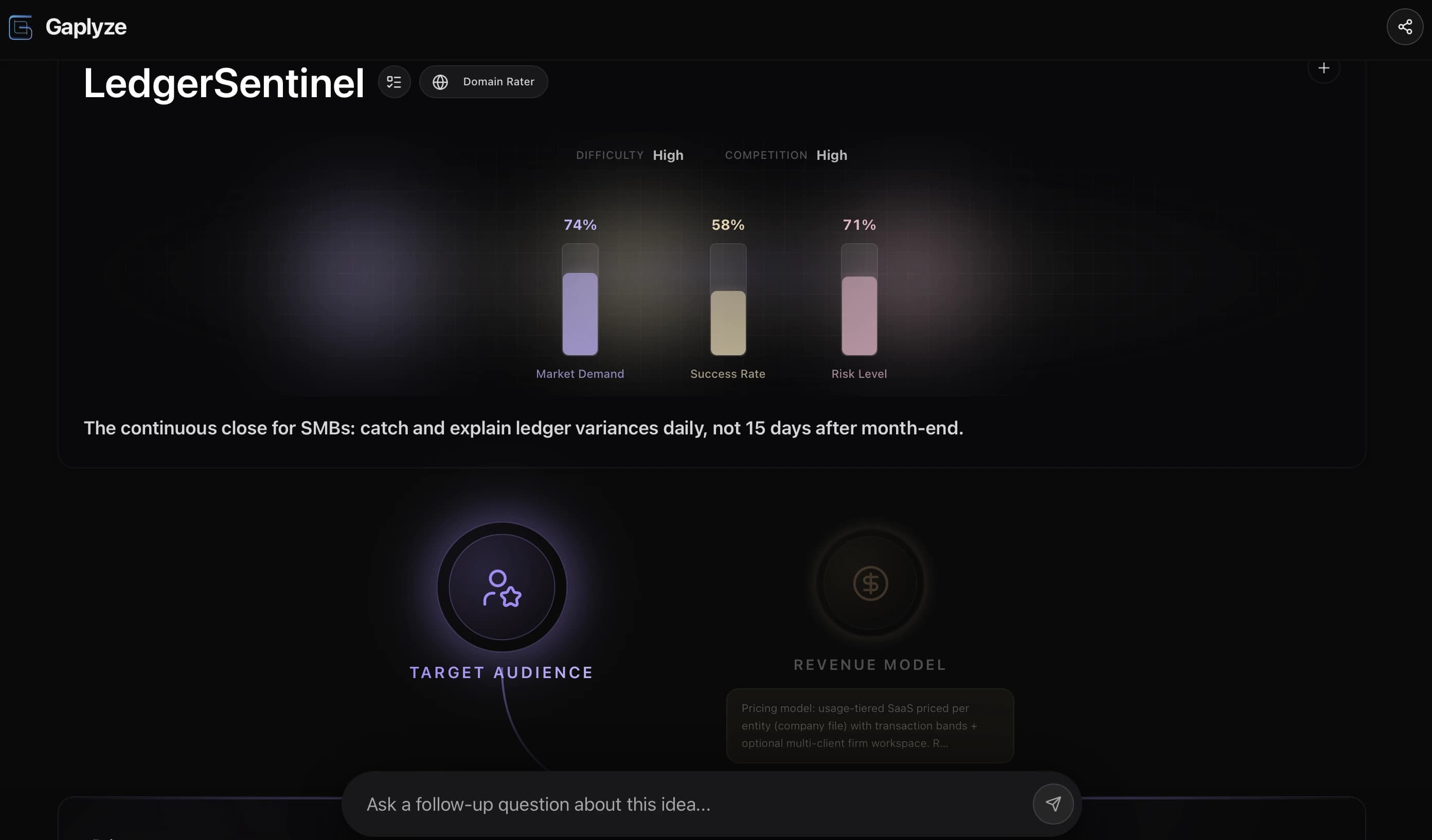
A single overall number flattens everything that matters. The reason an idea is strong is never the same as the reason it is risky, so a credible validation breaks the opportunity into distinct dimensions you can read independently. Gaplyze's Idea Score evaluates eight, each on the same nine-tier scale — so a 75 means the same thing every time — and each carries a confidence level and a written rationale, so you see not just the score but the reasoning and how sure the model is.
Market demand asks whether enough people feel this pain urgently. Success probability is the forward-looking, realistic ceiling — the honest odds, not the optimistic ones. Competition gauges how crowded and defended the space already is. Innovation asks whether your approach is genuinely differentiated or a thin re-skin of something that exists. Scalability tests whether growth compounds or grinds. Time to market estimates how fast a small team reaches a first paying user. Cost efficiency weighs the capital and effort required against the return. Risk level surfaces what could kill it — regulatory, technical, market, or execution.
Read together, the eight produce a profile, not a slogan. High demand with low feasibility is a specific, answerable question: can you overcome the execution gap? High innovation with high competition warns that being clever is not the same as being defensible. Beyond the dimensions, the Idea Score adds an executive summary, a full SWOT, a commercial verdict drawn from a set of distinct profiles, an early unit-economics projection, and — most usefully for a skeptic — the three to five killer assumptions your idea quietly depends on.
See your idea scored across all eight dimensions
Submit your idea — and optional context about your team, budget, and stage — for a nine-tier score per dimension with confidence, rationale, SWOT, a commercial verdict, and the killer assumptions you need to test next.
Reading the Verdict and Hunting Killer Assumptions
The most dangerous thing you can do with a validation report is read the headline and stop. A high overall score earned on the strength of demand can still rest on a single fragile belief — that you can acquire customers cheaply, that incumbents will not respond, that the regulation holds. Those are killer assumptions: the load-bearing beliefs that, if false, collapse the whole case regardless of how good everything else looks.
This is exactly why Gaplyze surfaces them explicitly and tags every supporting claim. Through its Evidence Ledger, each finding is marked as supported with a source, inferred from related signals, or missing proof. Instead of a smooth narrative that hides its weakest joints, you get an honest inventory: here is what the evidence backs, here is what we reasoned toward, and here is what nobody can confirm yet. The 'missing proof' items are not a failure of the tool — they are your to-do list, the precise experiments worth running before you commit.
So read a verdict like a skeptic. Start with the lowest-confidence dimensions and the missing-proof claims, not the score. Ask what single fact, if you learned it tomorrow, would change your decision — then go learn it. Validation done well does not end the conversation with a green light; it hands you a shortlist of the cheapest, highest-leverage questions left to answer.
A verdict that ignores your reality is noise. A path that suits a funded team can be ruinous for a bootstrapped solo founder. Gaplyze's Project Framing Memory captures your team, budget, runway, stage, and geography and threads that context through every score and recommendation — so the advice fits the founder you actually are, not a generic one.
Validating Without Building a Single Feature
The most expensive way to validate is to build the product and wait. Yet that is what most founders default to, because building feels like progress. Real validation is cheaper, faster, and almost always done before a line of code. The principle: test the riskiest assumption with the smallest possible experiment.
The toolkit is well established. Customer interviews using the Mom Test cost nothing but humility. A fake-door test — a landing page describing the offer with a sign-up or pre-order button — measures whether interest survives contact with a price, not just a survey. Pre-selling, where people pay before the product exists, is the most honest signal of all: money is the only opinion that cannot be polite. A concierge approach, delivering the outcome manually before automating it, proves people want the result without you building the machine.
Where Gaplyze fits is upstream of all of these: it tells you which assumption is riskiest, so you run the right experiment instead of an expensive one. The killer assumptions, the missing-proof items in the Evidence Ledger, and the lowest-confidence dimensions together form a prioritized test list. You spend your weekends proving the one thing that matters — not building the whole thing and discovering, too late, that the one thing was never true.
Gaplyze vs. ValidatorAI, IdeaProof, and the Two-Second Verdict
It is worth being precise about the contrast, because 'AI idea validator' now covers tools that work in fundamentally different ways. ValidatorAI offers a popular AI advisor that scores an idea and is free at its core, with a large top-of-funnel following. IdeaProof markets a test in roughly 120 seconds against a long criteria list, with TAM-style estimates and investor-ready assets. Both are real products solving for speed and reassurance, and for a first gut-check that has value.
The honest difference is depth and traceability, not speed. Gaplyze scores across eight named dimensions on one consistent nine-tier scale, attaches a confidence level and rationale to each, and — unlike a single fast verdict — exposes an Evidence Ledger that tags every claim as supported, inferred, or missing proof. It is framing-aware, weighing your actual team, budget, and stage rather than a generic founder. And it sits inside a connected journey: validation flows into strategy, competitive landscape, blueprints, and a roadmap, so a positive verdict becomes a plan rather than a dead end.
A fairness note, because honesty cuts both ways. The widely repeated criticisms of rival validators — 'says yes to everything,' 'no sources,' headline accuracy figures with no methodology — circulate heavily in published content, but much of that content is authored by competing vendors ranking their own tools, so treat those specific quotes as marketing rather than neutral fact. The genuinely neutral, well-documented issue is that AI tools can fabricate citations and confidence. Our answer to that is not a louder claim; it is the Evidence Ledger and multi-source research — a structural way to show our work, which you can verify yourself rather than take on trust.
Turning a Validated Idea Into a Decision You Can Defend
A validation process is only as good as the decision it produces. The end state is not a number to celebrate or mourn; it is a position you can defend to a co-founder, an investor, or yourself at 2 a.m. when the doubt arrives. That means knowing which dimensions are strong and why, which assumptions are still unproven, and what you would need to see to change your mind.
Practically, a disciplined first pass is short. Talk to a handful of real prospective users with the Mom Test. Run an Idea Score to get the eight-dimension profile, the verdict, and the killer assumptions. Read the Evidence Ledger and pull out every missing-proof item. Design the cheapest experiment that attacks the riskiest assumption. If the signals converge — interviews, demand, and scores pointing the same way — go deeper. If they diverge, you have learned something genuinely valuable for the price of an afternoon instead of a year.
That is what validating honestly buys you: not the comfort of a two-second yes, but the confidence of a decision built on evidence you can see. Score your idea, read the verdict like a skeptic, test what is unproven, and only then commit. The founders who survive are not the ones who validated fastest. They are the ones who refused to fool themselves.
Written by
Eli AbdeenFounder of Gaplyze — the product-intelligence OS that turns raw ideas into investor-ready product bets. More about the team →
Keep Exploring
Validate your idea honestly — evidence, not a two-second yes.
Run a free Idea Score for an eight-dimension, nine-tier profile with confidence, rationale, SWOT, a commercial verdict, killer assumptions, and an Evidence Ledger that shows exactly what is supported, inferred, or still unproven.
Frequently Asked Questions
How do I validate a startup idea before building anything?+
Validate by gathering evidence, not by building. First, interview ten to fifteen real prospective users with the Mom Test — ask about what they did the last time the problem occurred and what they already pay to deal with it, never whether they would use your idea. Next, read demand signals across multiple sources to confirm the problem at scale. Then run an Idea Score for an eight-dimension profile and a list of killer assumptions, and design the cheapest experiment — a fake-door page or a pre-sale — that tests the riskiest one. You only build after the evidence converges.
Can you trust AI startup idea validators?+
Only the ones that show their work. Many AI validators return a confident verdict in seconds with no sources and a tendency to encourage almost any idea — useful as a first gut-check, but not real validation. Trust a validator only if it tells you which signals it read, explains why each score landed where it did, and is willing to mark what it could not verify. Gaplyze does this through an Evidence Ledger that tags every claim as supported, inferred, or missing proof, and through multi-source research you can inspect rather than take on faith.
What does an 8-dimension idea score actually measure?+
Gaplyze's Idea Score rates eight distinct dimensions on the same nine-tier scale: market demand, success probability, competition, innovation, scalability, time to market, cost efficiency, and risk level. Each carries a confidence level and a written rationale, so you see the reasoning, not just a number. Together they form a profile that reveals why an idea is strong and where it is vulnerable, alongside an executive summary, a full SWOT, a commercial verdict, an early unit-economics projection, and the three to five killer assumptions your idea depends on.
How is Gaplyze different from ValidatorAI or IdeaProof?+
The core difference is transparency and depth rather than speed. Tools like ValidatorAI and IdeaProof are built for a fast verdict and reassurance. Gaplyze scores across eight named dimensions on one consistent scale, attaches confidence and rationale to each, exposes an Evidence Ledger that marks claims as supported, inferred, or missing proof, and is framing-aware — weighing your real team, budget, and stage. It also sits inside a connected journey, so a positive verdict flows into strategy, blueprints, and a roadmap instead of ending at a score.
What are killer assumptions and why do they matter?+
Killer assumptions are the load-bearing beliefs your idea quietly depends on — that you can acquire customers cheaply, that incumbents will not respond, that a regulation holds. If even one is false, the case collapses no matter how high your overall score looks. They matter because the headline number can hide a single fragile joint. Gaplyze surfaces three to five of them explicitly and, through the Evidence Ledger, flags which claims are still unproven — turning your validation report into a prioritized list of the cheapest, highest-leverage experiments to run next.