
Will My Startup Idea Make Money?
Commercial viability is not a feeling — it is four questions with evidence behind them: will people pay, do the unit economics work, is the market big enough, and does the monetization model hold? Here is how to read each one honestly before you build.
Table of Contents
Will My Idea Make Money? The Honest, Short Answer
Whether your startup idea will make money comes down to four questions, and you can answer all four before writing a line of code. Will a specific group of people actually pay for the outcome — not just say they like it? Do the unit economics work, meaning the cost to acquire a customer is comfortably less than the value that customer brings over their lifetime, at a margin that survives? Is the market large enough that a small slice of it is a real business? And does your monetization model match how customers prefer to buy? If all four hold up under evidence, the idea has commercial viability. If any one fails, the others rarely save it.
Most founders skip straight to the build because building feels like progress and pricing feels like a problem for later. That is precisely backwards. The most expensive way to discover that nobody will pay is to ship the product and watch the trial-to-paid number stay flat. Commercial viability is the cheapest thing to test early and the most painful thing to discover late, so it deserves the same rigor you would give the product itself — interrogated, sourced, and stress-tested rather than assumed.
This guide walks through the four questions one at a time, then shows how Gaplyze grounds each in evidence: a commercial verdict and an early unit-economics projection inside the Idea Score, the market-demand and cost-efficiency dimensions, and a dedicated Business Model blueprint that turns a willing audience into a revenue architecture you can defend.
A thousand people saying 'I'd use that' is not a single person paying. The graveyard of startups is full of beloved products with no buyers. When you assess whether your idea will make money, treat every signal that costs the respondent nothing — a like, a survey tick, a 'sounds useful' — as noise until it is corroborated by something that costs them something: time, a sign-up with a price attached, or money on the table.
Question One: Will People Actually Pay (Willingness to Pay)?
Willingness to pay is the foundation of commercial viability, and it is the question founders are most tempted to fake. The trap is asking 'would you pay for this?' — a hypothetical that invites a polite yes from people who will never open their wallet. Real willingness-to-pay evidence comes from behavior, not opinion. The strongest signal is an existing budget: what do your prospective customers already spend to solve this problem today, whether on a competing tool, a freelancer, a manual workaround, or their own wasted hours? Money already moving toward the problem is the clearest proof that more money can move toward your solution.
Beyond existing spend, the credible tests are the ones with a price attached. A fake-door landing page with a real 'buy' or 'start trial' button measures whether interest survives contact with a number. Pre-selling — taking payment before the product exists — is the most honest signal there is, because money is the only opinion that cannot be polite. Established research methods like Van Westendorp and Gabor-Granger pricing surveys can sharpen the range once you have a willing audience, but they refine a signal; they do not create one.
Gaplyze grounds this directly. The Idea Score builds a structured Ideal Customer Profile that includes an explicit willingness-to-pay signal alongside the current alternative each segment uses and the switching cost they would face. When you move into strategy, the Business Model blueprint goes further with a willingness-to-pay sensitivity section — naming the research method behind each estimate and, when an estimate is only an internal guess, flagging it as a pricing-confidence risk rather than dressing it up as fact.
Question Two: Do the Unit Economics Work (CAC, LTV, Margin)?
An idea people will pay for can still lose money on every customer. Unit economics is the math that decides whether revenue becomes profit, and it rests on three numbers. Customer acquisition cost (CAC) is what you spend in marketing and sales to win one paying customer. Lifetime value (LTV) is the total margin that customer generates before they churn. Gross margin is the share of revenue left after the direct cost of serving them. The single most important relationship is the ratio of LTV to CAC: if it is below 1, you lose money on every customer you acquire; around 3:1 is the classic line for a healthy software business, and meaningfully above that signals strong economics.
Two more levers decide the texture of the business. Payback period — how many months of margin it takes to recover the CAC — governs how much cash you burn to grow; a long payback can starve a bootstrapped founder even when the LTV:CAC ratio eventually looks great. And gross margin sets the ceiling on everything: a high-margin software product can absorb mistakes that a thin-margin, ops-heavy model cannot. The honest move early is to estimate these as ranges, not false-precision point figures, and to write down the assumption behind each one.
This is exactly what the Business Model blueprint produces. It commits a revenue archetype and the value metric your revenue scales with, then projects a blended CAC range, a lifetime value range, a payback period in months, and a gross-margin range — each with a stated basis. Crucially, the LTV:CAC ratio and its health grade are computed automatically from your CAC and LTV ranges rather than authored by the model, and that grade is read against standard SaaS bands — unviable, marginal, healthy, or strong — so the verdict is calibrated, not invented.
“Revenue tells you people will pay. Unit economics tells you whether paying customers make you richer or poorer. A startup makes money only when LTV comfortably exceeds CAC at a margin that survives.”
Question Three: Is the Market Big Enough to Matter?
Even healthy unit economics fail if there are not enough customers to multiply them by. Market size is the third pillar of commercial viability, and the useful question is not the inflated total addressable market that fills pitch decks but the serviceable, reachable slice you could realistically win. A profitable niche of a few thousand reachable customers paying real money can be a fine business; a tiny niche with no room to grow caps your ceiling no matter how clever the product. The danger runs both ways — a market too small to sustain a business, and a market so large and crowded that capturing a viable slice is its own losing battle.
The credible way to read market size is through demand evidence, not a top-down guess. Are problem-oriented searches rising, signaling growing unmet awareness? Are communities full of recurring complaints and homemade workarounds? Are recent launches gaining traction, proving the category is fundable, and is capital flowing in? Convergence across these independent signals is far more trustworthy than any single number — and far more honest than multiplying a population by a price you hope to charge.
Gaplyze handles market size through its market-demand dimension, which asks whether enough people feel this pain urgently, scored on the same nine-tier scale as every other dimension and carrying a confidence level and written rationale. It reads demand signals across multiple sources rather than asserting a number from thin air — and it deliberately will not fabricate a market-size statistic it cannot ground, which is the opposite of the tools that hand you a confident TAM with no methodology behind it.
Get a commercial verdict on your idea
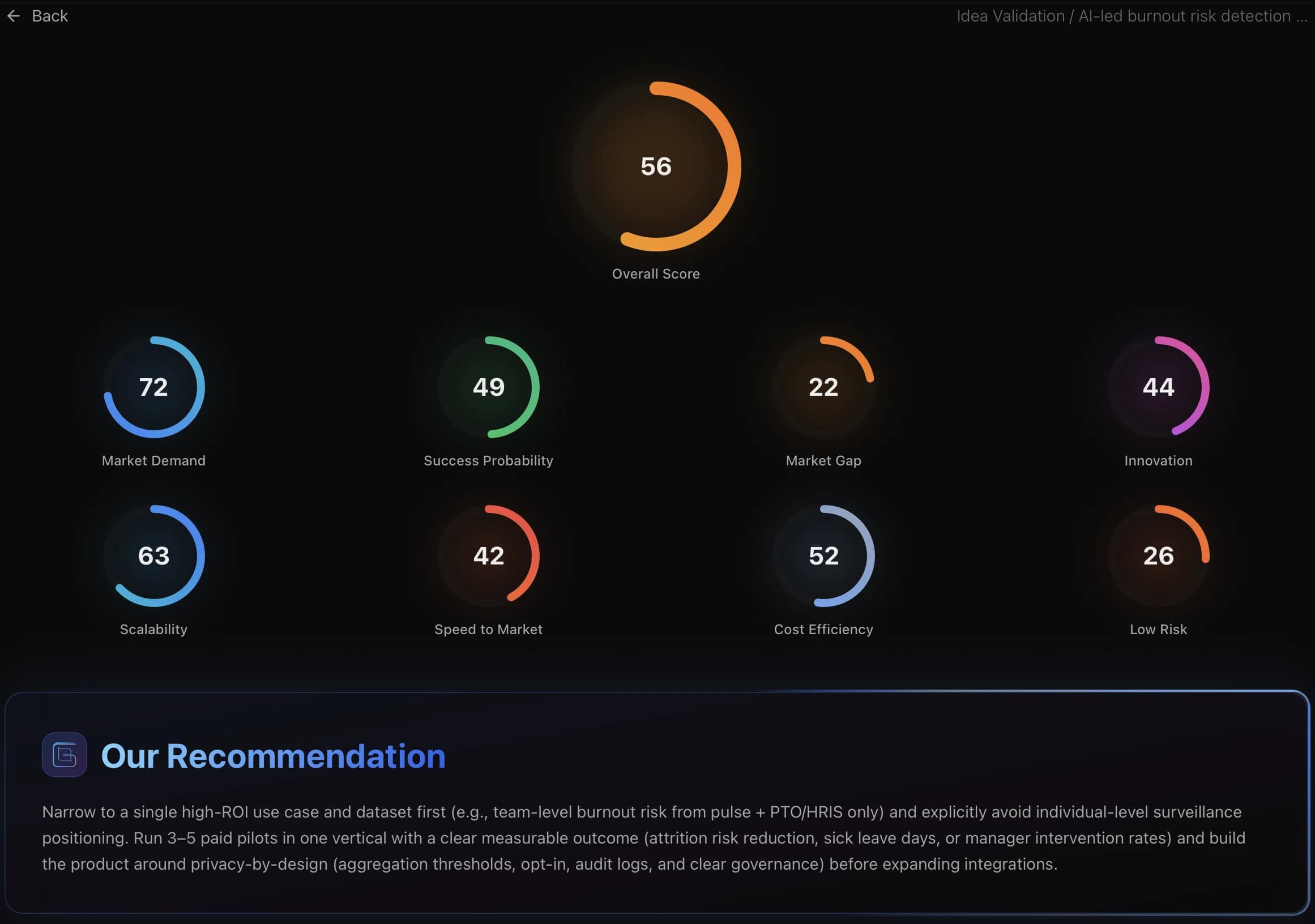
Run a free Idea Score for an eight-dimension profile — including market demand and cost efficiency — plus a commercial verdict, an early unit-economics projection, a structured willingness-to-pay signal, and the killer assumptions your revenue quietly depends on.
Question Four: Does Your Monetization Model Fit?
The same product can make money or fail purely on how it charges. Monetization model is the fourth question, and it has two parts: the mechanism (subscription, usage-based, transactional take rate, marketplace fee, one-time, hybrid) and the value metric — the thing your price scales with, such as seats, usage, transactions, or outcomes. A great value metric aligns what you charge with the value the customer receives, so the bill grows as their success grows. A mismatched one — charging per seat for a product used by a single power user, or a flat fee for a service whose cost scales with usage — quietly erodes the unit economics you worked to prove.
The model also has to fit how customers prefer to buy. Enterprises tolerate annual contracts and procurement; prosumers want self-serve and monthly billing; a high-frequency, low-stakes purchase suits usage-based pricing far better than a heavyweight subscription. Choosing the mechanism before you understand the buyer is how founders strand good products in the wrong checkout flow.
The Business Model blueprint commits this deliberately. It names the revenue archetype and the value metric, lays out the revenue streams with the economic logic behind each, and ties the model back to the unit economics so the mechanism you pick is consistent with the margins you need — a path to viability with a break-even condition and the assumptions it depends on, not a pricing page bolted on at the end.
Whether an idea 'makes money' depends on who is asking. A payback period that is fine for a funded team can sink a bootstrapped solo founder on finite runway. Gaplyze's Project Framing Memory captures your team, budget, runway, and stage and threads that reality through the cost-efficiency dimension and the unit-economics projection — so the commercial verdict is judged against the founder you actually are.
Putting the Four Questions Together: Reading the Commercial Verdict
No single one of the four questions decides commercial viability — the answer lives in how they combine. Strong willingness to pay with broken unit economics is a business that grows itself broke. Healthy economics in a market too small is a lifestyle project, not a venture. A big market with a mismatched monetization model leaves money on the table for a competitor to take. The discipline is to hold all four in view at once and find the weakest link, because that weakest link is what determines whether the idea makes money — not the strongest one you are tempted to celebrate.
Gaplyze synthesizes this into a commercial verdict drawn from a set of distinct profiles, sitting alongside the eight-dimension score, the early unit-economics projection, and — most usefully for a skeptic — the three to five killer assumptions your case depends on. The verdict is not a slogan; it is read together with the cost-efficiency dimension (capital and effort against return) and the market-demand dimension (urgency and scale), each with confidence and rationale, so you see why the verdict landed where it did rather than taking a number on faith.
Then read it like a skeptic. Start with the lowest-confidence dimensions and the riskiest assumption about revenue — usually that you can acquire customers cheaply enough, or that the market will pay your target price. Ask what single fact, learned tomorrow, would change your decision, and go run the cheapest experiment that learns it. A startup that makes money is rarely the one with the most confident projection. It is the one whose founder found the weakest link early and either fixed it or walked away before the build.
Written by
Eli AbdeenFounder of Gaplyze — the product-intelligence OS that turns raw ideas into investor-ready product bets. More about the team →
Keep Exploring
Find out whether your idea will actually make money.
Run a free Idea Score for the eight-dimension profile, a commercial verdict, and an early unit-economics projection — then turn a willing audience into a revenue architecture with the Business Model blueprint: CAC, LTV, payback, margin, and a calibrated LTV:CAC health grade.
Frequently Asked Questions
How do I know if my startup idea will make money?+
Answer four questions with evidence, not optimism. Will a specific group actually pay — proven by existing spend, a pre-sale, or a priced sign-up rather than a survey yes? Do the unit economics work, meaning lifetime value comfortably exceeds customer acquisition cost at a healthy margin? Is the reachable market big enough that a realistic slice is a real business? And does your monetization model match how customers prefer to buy? If all four hold up, the idea has commercial viability. Gaplyze's Idea Score gives you a commercial verdict, an early unit-economics projection, and the killer assumptions your revenue depends on.
What unit economics decide whether a startup is profitable?+
Three numbers and two levers. Customer acquisition cost (CAC) is what you spend to win one paying customer; lifetime value (LTV) is the total margin they generate before churning; gross margin is the share of revenue left after serving them. The key relationship is the LTV:CAC ratio — below 1 you lose money on every customer, and around 3:1 is the classic healthy line. The two levers are payback period (how many months of margin recover the CAC) and gross margin (which caps everything). Gaplyze's Business Model blueprint projects these as ranges and computes the LTV:CAC ratio and a calibrated health grade automatically.
How big does my market need to be for the idea to make money?+
Big enough that a realistic, reachable slice sustains a business — not the inflated total addressable market on a pitch deck. A profitable niche of a few thousand reachable customers paying real money can be excellent; a tiny niche with no room to grow caps your ceiling, and an enormous crowded market can be just as hard to win a viable share of. Read market size through demand evidence — rising problem-searches, recurring community complaints, funded launches — rather than a top-down guess. Gaplyze's market-demand dimension scores this on a nine-tier scale with confidence and rationale, and will not fabricate a market-size number it cannot ground.
Why does my monetization model affect whether I make money?+
Because the same product can win or lose purely on how it charges. The mechanism (subscription, usage-based, take rate, one-time, hybrid) and the value metric — the thing your price scales with — determine whether revenue tracks the value customers receive. A mismatched value metric, like charging per seat for a single-power-user product, quietly erodes good unit economics. The model also has to fit how the buyer prefers to purchase. Gaplyze's Business Model blueprint commits the revenue archetype, the value metric, and the revenue streams, and ties the model back to your unit economics so the mechanism is consistent with the margins you need.
Can an AI tool really judge a startup's commercial viability?+
Only one that shows its reasoning and refuses to invent numbers. Many tools hand you a confident revenue projection or TAM with no sources — useful as a gut-check, not as proof. Gaplyze grounds commercial viability in evidence: a market-demand and cost-efficiency dimension each with confidence and rationale, a commercial verdict from a set of distinct profiles, an early unit-economics projection, and a willingness-to-pay signal — and the deeper Business Model blueprint computes the LTV:CAC grade from your own CAC and LTV ranges and flags pricing estimates that are only internal guesses, rather than presenting them as fact.