
Opportunity Mapping·12 deliverables
- Opportunity Map
- Framed Candidates
- Market Niches
- Customer + ICP
- Problem + Urgency
- Outcome + Wedge
- Viability Estimate
- Sibling Variants
- Competitor Signal
- Topic Framing
- Ready to Score
- Downstream Context
The job
Founders waste months brainstorming ideas that were never structured to be scored.
Raw brainstorm output isn't an idea — it's a sentence. The Idea Generator gives you framed candidates ready for the next step: scoring, refinement, and strategic comparison.
You bring
- A topic or industry you care about
- A competitor URL (paste from the address bar)
- A vague hunch from a meeting or commute
Gaplyze creates
- Multiple framed idea candidates with customer + problem + outcome
- Sibling variants you can compare side by side
- Each candidate ready to score in one click
The real surface
From one input to a mapped field of opportunities.
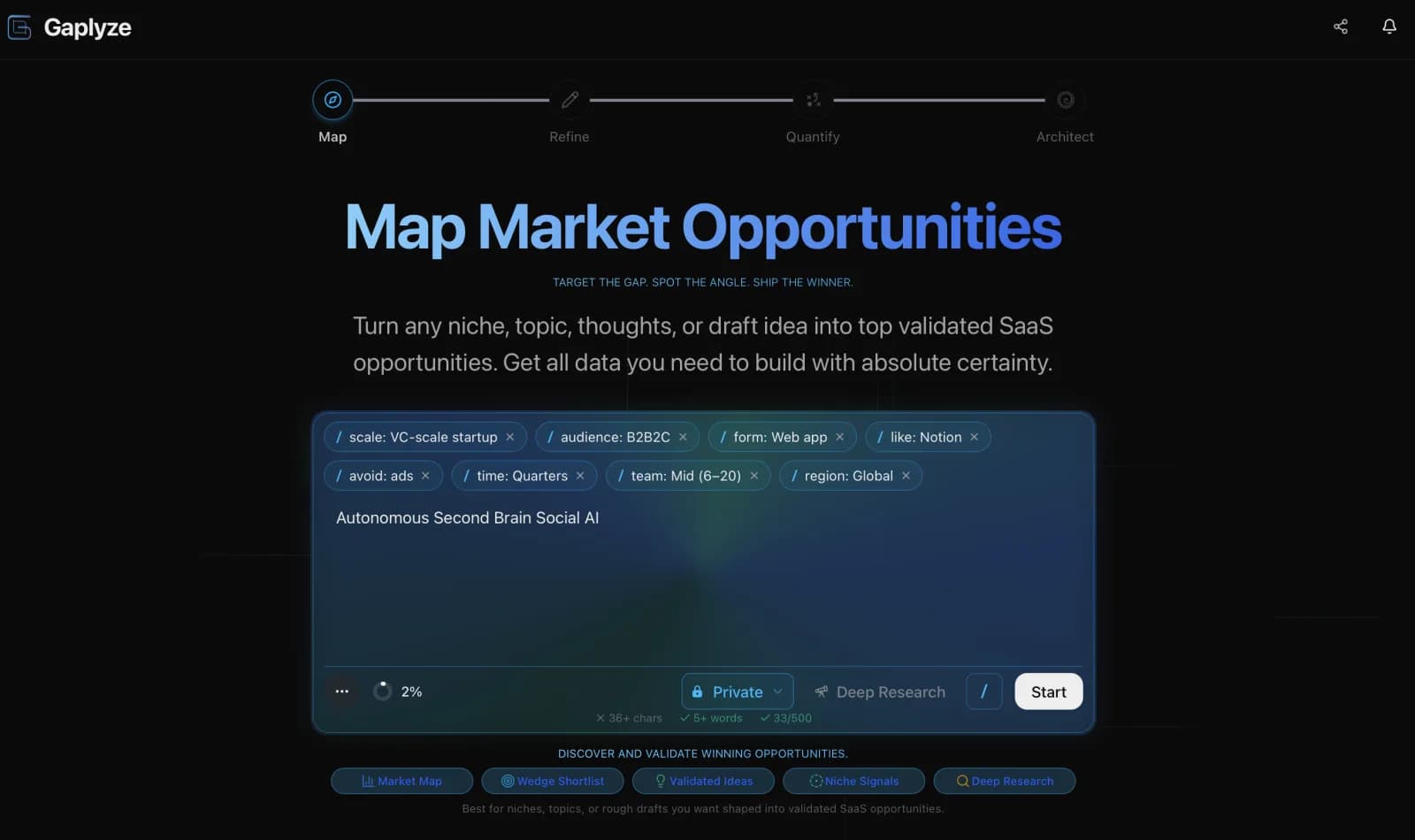
The actual opportunity map — market niches, framed candidates, and the demand and competitor signals behind each one. Open it and scroll the whole thing.
Decision unlocked
You leave the session with candidates ready to compare, not a notebook of fragments.
Pick which one to score first — and which to park
See sibling variants you would have missed brainstorming alone
Move straight from candidate to scored opportunity — no rewrite
Where it fits
The first step of the Gaplyze chain.
Idea Generator
Refinement
Idea Score
Strategy Map
Blueprints
Idea Generator
You are hereRefinement
Idea Score
Strategy Map
Blueprints
The candidates you generate here feed Refinement and Scoring directly — no copy-paste, no context loss.
Start free
Generate your first idea candidates for free.
No credit card. Generate, refine, and compare — upgrade only when you want deeper scoring, market intelligence, or investor-ready exports.
FAQ
Questions founders ask before they start.
What does the Idea Generator actually produce?
A set of distinct, deeply framed startup candidates — each one carrying a named customer segment with explicit ICP cues, the underlying problem with its urgency and frequency signal, the outcome you're delivering with the wedge that makes it defensible, an estimate of commercial viability per dimension, and the structured context that every downstream step (Refinement → Idea Score → Strategy Map → Market Intelligence → Blueprints → Roadmap → Investor Export) inherits without copy-paste or context loss. Generic LLM brainstorming hands you sentences; the Idea Generator hands you the venture's spine.
How is this different from brainstorming with ChatGPT, Claude, Perplexity, or any general-purpose LLM?
A general-purpose chat gives you fluent text — a list of plausible-sounding ideas that the model forgets the second the thread ends. The Idea Generator gives you persistent, structured candidates: each one anchored to a real customer + problem + wedge + viability signal, each one inherited by the rest of the chain without re-prompting. You can refine a candidate, compare it to siblings, score it on commercial viability, lock a strategic path, generate the Blueprint Operating System on top, and export the investor-ready memo — all from the same structured object. ChatGPT / Claude / Perplexity don't lose the conversation; they lose the COMMITMENT — the structured artifact your team and your investors can audit.
Can I refine the ideas it generates?
Yes. Every generated idea can be refined, compared with siblings, and iterated on. The refinement step tightens the wedge before scoring.
Does it work for any topic?
Anywhere there's a customer with a real problem — SaaS, marketplaces, fintech, AI tools, vertical software, prosumer apps. The Generator frames the input first, then proposes candidates fitted to that frame.
Do I need to be technical?
No. The Generator speaks founder, not engineer. You describe a topic or paste a competitor URL; Gaplyze does the structure.
What happens after I generate ideas?
You pick one or more candidates to score, refine, or compare. Scored ideas unlock strategic-path mapping, market intelligence, blueprints, and an investor-ready export.
Stop brainstorming. Start scoring.
Generate framed startup ideas — and feed them straight into a chain that ends in an investor-ready plan.