
Marketing Intelligence · Market Intelligence
Quantified market intelligence for the path you chose.
Marketing Intelligence·12 deliverables
- Demand Heatmap
- Evidence Ledger
- Market Radar
- Competitor Signals
- Channel Readiness
- Gap Identification
- Opportunity Sizing
- Saturation Analysis
- Narrative Shift
- Audited Sources
- Confidence Bands
- Downstream Context
The job
A scored idea + chosen path means nothing if the market intelligence behind it is vibes.
Most market research is either a slide deck nobody reads or a Google Doc nobody trusts. Market Intelligence in Gaplyze is structured, sourced, and scoped to the path you committed to — the evidence base your team and your investors can audit line by line.
You bring
- A scored idea with a chosen strategic path
- A short list of competitors you already track
- Optional: notes from buyer calls or analyst reports
Gaplyze creates
- A demand heatmap scoped to your buyer segments and funnel stages
- An Evidence Ledger with sourced findings and confidence bands
- A 5-axis market radar — demand, competition, channel, switching, sophistication
The real surface
The evidence base, up close.
The actual Marketing Intelligence surface — the demand heatmap, the market radar, and the Evidence Ledger where every finding links back to a source you can audit. Open it and scroll the whole thing.
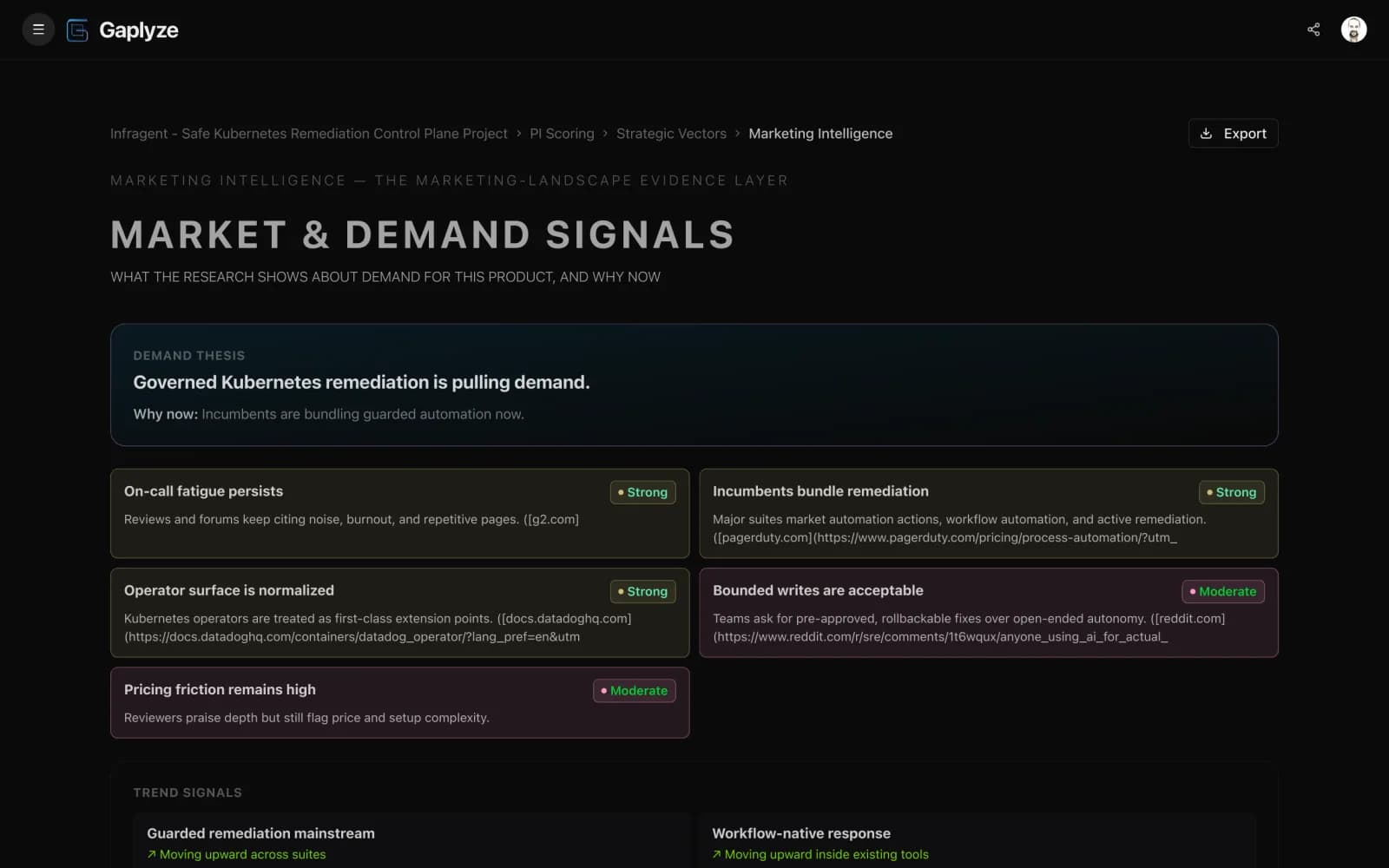
Inside Market Intelligence
A structured evidence base scoped to the path you committed to.
Market Intelligence is not a research dump. It is the structured, sourced, scoped-to-your-path operating layer that turns the market into decisions your team and your investors can audit.
Competitor surface tracking
Every competitor finding carries a source URL, a timestamp, and a confidence band you can audit. Pricing-page audits, changelog drift, careers-page signals, public RFP filings — every claim traces back to a surface you can open.
Demand-pattern surfacing
Where is intent actually concentrated, and how is it moving? The demand layer aggregates signals across the funnel — awareness through expansion — and across your buyer segments, surfacing where heat compounds and where it decays.
Channel-readiness posture
Which distribution channels are open, which are crowded, which are dormant? Channel-readiness weighs cost of attention, channel saturation, your team's channel muscles, and the competitive narrative already in play.
Gap identification
The most valuable signal MI surfaces is what's MISSING from the competitive landscape — unbundled workflows nobody owns, segments everyone ignores, channels nobody rides, value props incumbents are forced to dilute. Gap identification is the structured search for your sharper wedge.
Opportunity sizing
What's the addressable opportunity at the segment level, and what's the realistic share given your wedge and channel posture? Sizing is a defensible read of the bet — not a TAM-number on a slide.
Saturation analysis
When does a category stop being worth entering? Saturation analysis surfaces leading indicators of maturity — funding velocity, M&A activity, pricing pressure, narrative consolidation — so the bet is current.
Narrative-shift detection
What narratives are gaining momentum in the category, and which are losing it? The narrative layer reads analyst commentary, investor letters, and competitor positioning shifts to surface the trajectory of the conversation.
Evidence Ledger structure
Every finding lands in the Evidence Ledger — a structured record carrying the finding, source, timestamp, confidence band, and implication for your strategic path. The artifact your investor reads when they want to audit the case.
Downstream inheritance
The evidence base flows downstream — GTM blueprints inherit channel posture, Business Model blueprints inherit willingness-to-pay precedents, Foundation blueprints inherit positioning narrative, the investor memo cites the Evidence Ledger.
Every finding sourced. Every claim auditable. Every layer scoped to your locked strategic path.
Decision unlocked
You leave with the evidence base your strategy and your investors actually require.
Know exactly which segment + stage has the most heat — and which to deprioritize
Defend every claim in your investor memo with a sourced, time-stamped finding
Move into Blueprints with the channel posture and demand evidence already locked
Where it fits
Between Strategy Map and Blueprints.
Idea Score
Strategy Map
Market Intelligence
Blueprints
Execution Roadmaps
Idea Score
Strategy Map
Market Intelligence
You are hereBlueprints
Execution Roadmaps
Market Intelligence is the bridge from strategy to structure: the evidence base every blueprint downstream is built on.
Start free
Open Gaplyze, score an idea, and reach intelligence in one session.
No credit card to start. Intelligence runs on the path you commit to after Strategy Map — upgrade only when the depth of evidence you need outgrows the free tier.
FAQ
Market intelligence questions answered.
How does Gaplyze gather market signals?
Gaplyze pulls signals from competitor surfaces (pricing pages, changelogs, careers, docs), public demand data, and channel-readiness indicators. Each signal is captured with its source so you can audit the evidence behind every finding.
How are the sources verified?
Every finding in the Evidence Ledger carries a source URL, a timestamp, and a confidence band. You can open the original surface, recheck the claim, and override anything that has staled — confidence is a recommendation, not a gate.
How often does the intelligence refresh?
Findings are scoped to your selected strategic path and regenerated on demand. You decide when to refresh — the page tracks staleness per finding so you can re-pull only what matters before a big decision.
Can I use this for marketing intelligence instead of just market intelligence?
Yes — the channel-readiness axis powers the GTM and Content & Community blueprints downstream. Same evidence base, narrower lens: the signals that decide which channel and which content lane is worth the next 30 days.
Should I wait for full intelligence before scoring my idea?
No. Scoring runs on the framed idea; intelligence is for the path you commit to after scoring. The intelligence step belongs after Strategy Map — it sharpens the path you chose, not the score itself.
Is this enough for investor diligence?
The Evidence Ledger is structured for diligence — every claim is sourced, time-stamped, and exportable into the investor-ready memo. It is one input among several; investors still want the score, the strategy, and the team. Intelligence makes the memo defensible.
Continue reading
Next in the chain.
Strategy Map
Pick the strategic path intelligence is scoped to
Blueprints
Turn evidence into the GTM, Content & Community, and Business Model blueprints (with the marketing intelligence lens applied)
Execution Roadmaps
Carry the evidence base into delivery
Investor-Ready Exports
Export the Evidence Ledger into the investor memo
Stop guessing the market. Show the evidence.
Quantified intelligence, sourced findings, a demand heatmap your team can read in 30 seconds. Scoped to the path you actually chose.