
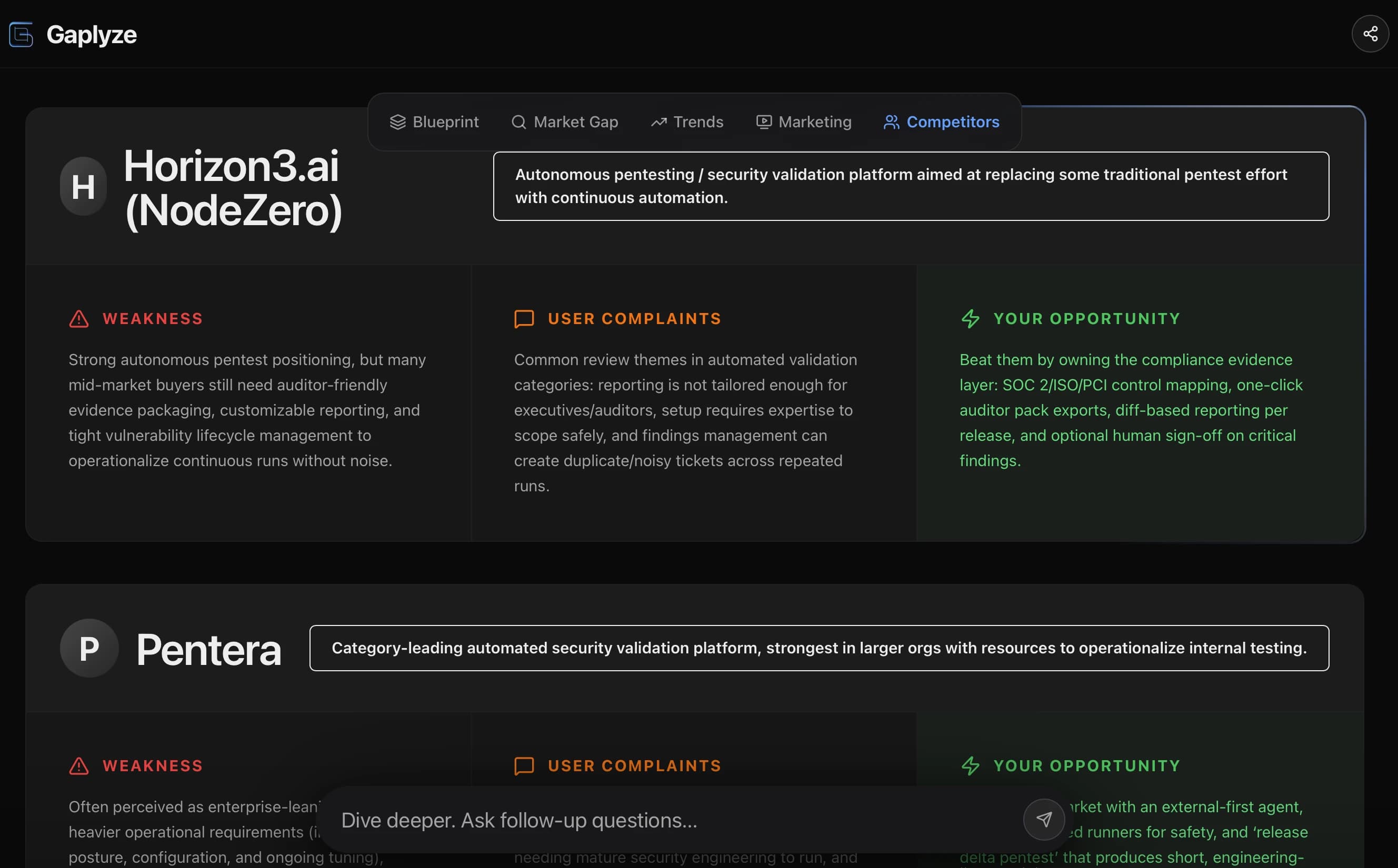
How to Audit a Competitor's Website for Gaps
A repeatable competitor website audit turns a rival's homepage into four scored verdicts — positioning gaps, review-sentiment weaknesses, moat strength, and growth levers — so your competitor analysis ends in moves you can make this week, not a tab full of screenshots.
Table of Contents
Competitor Website Audit: The Short Answer
A competitor website audit is a structured pass over a rival's public site that ends in four verdicts you can act on: where their positioning leaves a gap, where their customers are quietly unhappy, how defensible their moat actually is, and which growth levers they have not pulled. The method is the same every time — read the public surface for what it says and what it conspicuously avoids, cross-reference recent signals and review platforms for what customers report, then score each finding so the highest-leverage opening rises to the top. Done right, the audit takes minutes and ends in a move, not a feeling.
Most competitor analysis fails because it stops at observation. Founders open a rival's homepage, skim the pricing page, read a few G2 reviews, and come away with an impression — 'their messaging is sharper,' 'they seem to have traction' — that is true, vague, and useless. An impression cannot be sequenced. A scored gap can. The difference between competitive intelligence that changes your roadmap and competitive intelligence that just makes you anxious is whether the audit produces a ranked, comparable verdict you can hold up against your own.
This guide gives you that method, and then shows you how Gaplyze Web Insights runs it for you. You paste a competitor's URL; it returns a scored opportunity report — positioning and competitive landscape, recent signals, a moat assessment, review-and-sentiment intelligence, and the most valuable insights ranked by confidence. Because every report is scored on the same unified framework, a competitor's 67 means exactly what your own 67 means, and the gap between the two is where your strategy lives.
The point of a competitor website audit is not to admire a rival — it is to produce a ranked list of openings. 'Their positioning is muddled' is an observation. 'Their hero, pricing, and comparison pages each claim a different value prop, scoring a weak market position — your wedge is a single, sharper outcome statement' is a move. Audits that end in moves change your roadmap; audits that end in feelings just raise your blood pressure.
Why a Competitor Website Audit Beats Casual Snooping
Every founder snoops on competitors. Far fewer audit them, and the gap between the two is structure. Casual snooping is unstructured, unscored, and unrepeatable — you look at whatever catches your eye, you weight it by mood, and you cannot compare today's read against last quarter's or against your own site. A real competitor website audit fixes all three: it covers the same dimensions every time, it scores each one so findings are comparable, and it is cheap enough to re-run whenever a rival reposts or reprices.
Structure also protects you from the two failure modes of competitive analysis. The first is over-indexing on the loudest signal — a flashy redesign, a funding announcement — and rebuilding your strategy around a rival's marketing rather than their substance. The second is the opposite: dismissing a competitor because their site looks amateur, while their customers are deeply loyal and their moat is real. A disciplined audit reads both the surface and the evidence underneath it, so you react to what is true rather than what is loud.
The most useful discipline is to audit both sides on identical terms. Run the audit on the two or three competitors who keep beating you to a segment, then run the same audit on your own site. The openings you find in their gaps are only opportunities if your site does not have the same gaps — and the strengths you envy are only threats if your customers actually value them. Comparable scores make that judgment honest instead of anxious.
Step 1 — Read Positioning Gaps From the Public Surface
Start where every visitor starts: the homepage, the pricing page, and any comparison or 'why us' page. You are reading for three things — who they say they serve, the single outcome they promise, and the customer they implicitly exclude. Positioning gaps live in the inconsistencies. When the hero promises one outcome, the pricing tiers imply a different buyer, and the feature list emphasizes a third capability, the message is fragmented — and a fragmented message is a wedge for anyone who can state a single, sharper outcome.
The richest gaps are usually exclusions. A rival that positions hard for enterprise and hides anything below a four-figure price has handed the SMB story to you. A tool that names a workflow ('automate your reporting') instead of an outcome ('close the books two days faster') has left the outcome unclaimed. Write down not just what the site says, but what it conspicuously does not say — the segment it skips, the objection it never answers, the use case it implies but never names. Those silences are where positioning gaps hide.
Gaplyze Web Insights does this read for you and turns it into structure. It extracts the business identity, the core offerings and how mature each one is, the target market, the business model, and the pricing strategy when it is publicly visible — then assembles a competitive-intelligence section: the differentiators the site leans on, a positioning narrative for where they actually stand, and the direct, indirect, and alternative competitors that bracket them. Instead of an hour of clicking, you get a positioning map and a market-position score you can set beside your own.
Turn a competitor URL into a scored gap report
Paste any rival's public URL into Web Insights and get a scored report — positioning and competitors, recent signals, moat assessment, and review-sentiment intelligence — with the highest-leverage gaps ranked first.
Step 2 — Mine Review Sentiment for the Weaknesses Customers Confirm
A competitor's website tells you what they want to be true. Their reviews tell you what their customers actually experience — and the delta between the two is the most reliable gap you can find. A positioning gap is a hypothesis; a recurring complaint across G2, Trustpilot, Capterra, or Product Hunt is evidence. When the same frustration shows up again and again — slow support, a confusing onboarding, a missing integration, a pricing change that burned loyal users — you have found a weakness their marketing will never admit and their customers will happily switch over.
Read sentiment as a two-column ledger. In one column, the praises — the things customers love, which are exactly the strengths you must match or route around rather than attack head-on. In the other, the complaints — the recurring negatives that are your most defensible wedge, because you are not claiming superiority on a whim; you are answering a demand the market has already voiced. The complaints column is where 'we should differentiate somehow' becomes 'we should win the customers who keep asking for the thing this competitor refuses to ship.'
Web Insights compiles this for you. Its review-and-sentiment intelligence gathers the review platforms it can find, classifies the overall sentiment, and separates the most common praises from the most common complaints — and when there are not enough public reviews to be conclusive, it says so and labels the assessment as inferred rather than fabricating a rating. That honesty matters: a confidently wrong sentiment read is worse than an admitted gap in the evidence, because you would build a wedge on a customer pain that does not exist.
When you audit a competitor's review sentiment, treat the recurring complaints as a pre-validated feature and positioning shortlist. Each one is a customer pain the market has already articulated and a rival has chosen not to fix. You are not guessing at differentiation — you are answering demand someone else left on the table.
Step 3 — Assess the Moat Before You Pick a Fight
A gap is only worth attacking if you can hold the ground you take, which is why the third step of a competitor website audit is a sober moat assessment. The question is not 'are they winning today' but 'why, and for how long.' Look for the durable advantages: network effects that get stronger with every user, switching costs that trap their customers, proprietary data or distribution, brand trust that money cannot quickly buy, regulatory or ecosystem lock-in. A rival with an obvious positioning gap but a deep moat is a worse target than a rival with a clean site and no defensibility at all.
Be honest about the horizon, too. Some moats are real but short-lived — a first-mover lead that a fast follower erases, a feature advantage that commoditizes in a release cycle. Others are structural and compound over years. The growth levers a competitor has left unpulled — segments they ignore, channels they under-invest in, adjacent offerings they have not built — are only opportunities if their moat does not extend to cover them. Assessing the moat first stops you from charging at a gap that a defensible rival can close the moment you make it valuable.
Web Insights produces an explicit moat assessment: whether a defensible moat is observable, which specific moat types apply, an evidence-based narrative for the reasoning, and a defensibility horizon — short, medium, or long term. Paired with the growth-potential score and the opportunities in its strategic assessment, you get both halves of the judgment: how hard the rival is to dislodge, and which growth levers are still sitting unused for whoever moves first.
“A positioning gap behind a deep moat is a trap. A positioning gap with no defensibility behind it is a roadmap. The audit is what tells you which one you're looking at.”
The Competitor Website Audit Loop, in Five Moves
Pick the right targets
Choose the two or three competitors who keep beating you to a segment — not the biggest names, the ones whose customers you actually want. A focused audit of real rivals beats a shallow sweep of the whole category.
Run the URL through Web Insights
Paste each competitor's homepage or pricing page. You get a scored report — positioning and competitors, recent signals, moat assessment, and review-sentiment intelligence — in roughly the time it takes to read one of their blog posts.
Read the four gap layers
Work through positioning gaps, review-sentiment complaints, moat strength, and unpulled growth levers in that order. The first two reveal openings; the third tells you whether the opening is defensible; the fourth tells you where to push.
Audit your own site on the same terms
Run Web Insights on your own URL and compare scores head-to-head. A rival's gap is only your opportunity if your site does not share it, and their strength is only a threat if your customers value it too.
Convert the sharpest gap into a scored opportunity
Take the highest-confidence opening and convert it into your own scored idea or strategic move — so the audit ends in something you build against, not a screenshot you forget.
Reading Recent Signals Without Overreacting to Them
Recent signals — a funding round, a product launch, a partnership, a leadership change, a strategic pivot — are the part of competitor analysis founders most often get wrong. A fresh announcement feels urgent, so it gets over-weighted, and a quarter of roadmap gets rearranged around a competitor's press release rather than their substance. The discipline is to treat signals as context for the gaps you have already found, not as gaps in themselves. A funding round tells you a rival can now afford to close a gap faster; it does not tell you the gap is gone.
Recency and trust both matter. A high-trust signal from the last thirty days deserves more weight than a low-trust social post from last year, and a strategic pivot deserves more attention than a routine milestone. The right move is to ask, for each signal, 'does this change the defensibility of the gap I want to attack, or the speed at which the rival can respond?' If the answer is no, note it and move on. If the answer is yes, fold it into your moat and growth-lever assessment rather than letting it hijack the whole audit.
Web Insights surfaces recent signals categorized by type, dated, and bucketed by recency tier and source trust — and crucially, it returns an empty set rather than padding the report when there is no real public news. That restraint is the point: a competitor with no recent signals is itself a signal, and a tool that invents announcements to fill the section would corrupt the very judgment the audit exists to support.
From Audit to Action: Closing the Loop
An audit that does not change what you do is just expensive procrastination. The final move is conversion — taking the sharpest, highest-confidence gap and turning it into a decision: a positioning change, a feature on the roadmap, a segment you go after, a wedge you score as your own opportunity. Because Web Insights scores every report on the same unified framework as the rest of the platform, the gap you find does not stay trapped in a competitive-intel document; it can flow straight into a scored idea, a strategy path, and a plan, all threaded through the same context.
This is where a tool earns its place over a manual audit. You can absolutely run a competitor website audit by hand — open the tabs, read the reviews, sketch the SWOT. But you cannot easily score it comparably, you cannot re-run it cheaply when the rival reposts, and you cannot carry the finding forward into your own strategy without retyping everything. The audit's value is not the reading; it is the ranked, comparable, convertible output. That is the part worth automating.
So make the audit a habit, not an event. Run it on your sharpest rivals when you set strategy, re-run it when the competitive landscape shifts, and always close the loop by converting the best gap into a move. Competitive analysis stops being a thing you dread and becomes a fast, repeatable input to a strategy you can keep current — which is exactly what an audit is supposed to buy you.
Written by
Eli AbdeenFounder of Gaplyze — the product-intelligence OS that turns raw ideas into investor-ready product bets. More about the team →
Keep Exploring
Turn a competitor's URL into your next move.
Run a scored competitor website audit with Web Insights — positioning gaps, review-sentiment weaknesses, moat strength, and growth levers — then convert the sharpest opening into your own scored opportunity, all in one workspace.
Frequently Asked Questions
What is a competitor website audit?+
A competitor website audit is a structured, scored pass over a rival's public site that produces four verdicts: where their positioning leaves a gap, where their customers are unhappy, how defensible their moat is, and which growth levers they haven't pulled. Unlike casual competitor snooping, it covers the same dimensions every time and scores each one, so findings are comparable across rivals and against your own site — which means the audit ends in a ranked list of moves you can sequence, not a vague impression.
How do I find gaps in a competitor's website?+
Read the public surface for inconsistency and exclusion. When the homepage, pricing, and comparison pages each imply a different buyer or outcome, the message is fragmented and the wedge is a single, sharper claim. The segment they skip, the objection they never answer, and the use case they imply but never name are all positioning gaps. Then cross-reference review platforms: recurring complaints are pre-validated weaknesses. Gaplyze Web Insights does this read automatically — it extracts positioning, competitors, and pricing signals, then ranks the gaps by confidence.
Should I audit my own website too, or just competitors?+
Both, on identical terms. A rival's gap is only your opportunity if your own site doesn't share it, and a strength you envy is only a threat if your customers actually value it. Because Web Insights scores every report on the same unified framework, you can run your own URL through the same audit and compare scores head-to-head — a competitor's 67 means exactly what your 67 means. The gap between the two scores is where your strategy lives; auditing only the competitor leaves you guessing whether the opening is real.
How does Gaplyze Web Insights audit a competitor's site?+
You paste a competitor's public URL and Web Insights returns a scored opportunity report. It extracts the business identity, offerings, target market, business model, and pricing signals; assembles a competitive-intelligence section with differentiators, a positioning narrative, and named competitors; compiles review-and-sentiment intelligence separating praises from complaints; produces an explicit moat assessment with a defensibility horizon; lists recent signals dated and trust-tiered; and ranks the most valuable insights by confidence. It performs a standard public fetch — no login, no notification to the site owner.
How often should I re-run a competitor website audit?+
Run a full audit of your sharpest rivals whenever you set or revisit strategy, and re-run it whenever the competitive landscape shifts — a competitor reprices, reposts, ships a major feature, or raises a round. Because Web Insights performs a fresh fetch against the current page each time, a re-run gives you a new snapshot, not a stale cache, so you can track how a rival's positioning and sentiment move over time. The goal is to keep the gap between what you've learned about your competitors and what your strategy assumes as small as possible.