
Content and Community Blueprint · Audience Engine
A content engine + a community engine, feeding each other.
Content + Community Blueprint·12 deliverables
- Content Engine
- Community Engine
- Team Roles
- Editorial Voice
- Content Pillars
- Engagement Loops
- Repurpose Pipeline
- Rituals + Cadence
- Member Spotlights
- Resource Library
- Distribution Adjacency
- Downstream Feed
When it triggers
Content + Community generates after Foundation + Go-to-Market — not before.
You need to know who the audience is and how the launch motion runs before you commit to an always-on engine. Foundation gives the audience; Go-to-Market gives the motion; this blueprint defines the compounding adjacency.
An idea scored on commercial fit
A Foundation Blueprint locking customer + wedge
A Go-to-Market plan defining the launch motion
Strategic input
Read from strategy and evidence, not from yesterday's viral post.
From your Strategy Map
- Selected path with brand-voice hypothesis
- Story arcs the audience expects
- Trade-offs between depth and reach
From Market Intelligence
- Communities the customer already inhabits
- Content formats that win attention in the segment
- Tone of voice that signals trust to the audience
The real surface
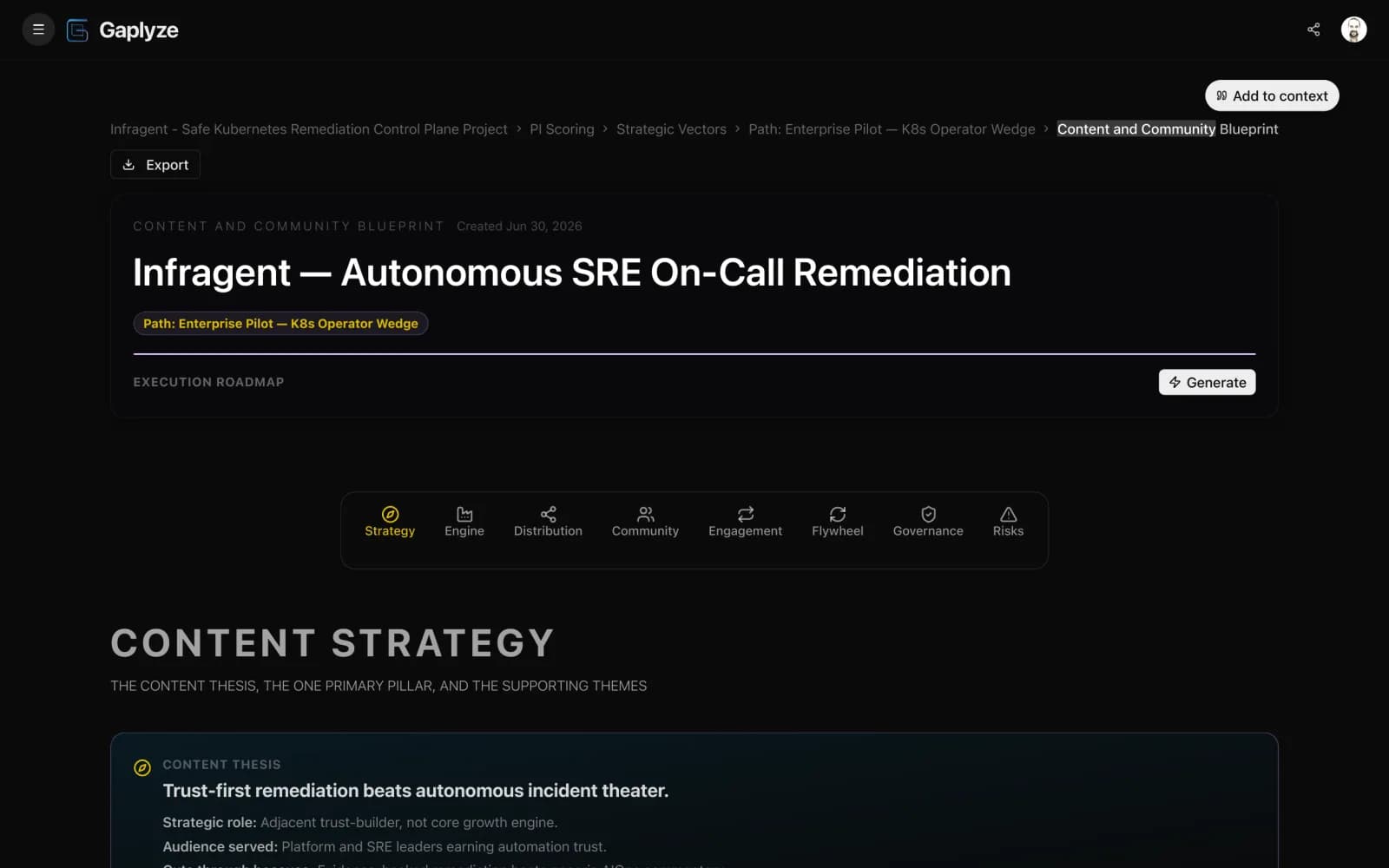
A content engine, a community engine, and the roles that run them.
The actual Content and Community Blueprint — the content engine, the community engine, the team roles (creator / curator / community manager), and the rituals that compound them. Open it and scroll the whole thing.
Roadmap outputs
From a content + community plan to the tasks your team executes.
Seed
- Author + publish the anchor content set
- Open the community space with first 50 invites
- Define the weekly cadence + first three rituals
Grow
- Move from invite-only to public application
- Ship the first member spotlight
- Activate creator/curator/manager roles
Compound
- Quarterly health audit (active rate + return cohort)
- Codify the resource library
- Retire dead loops, double down on live ones
Prompt-pack outputs
Context for your AI editorial + community agents.
Editorial briefing
Voice, pillars, formats, and audience packaged as a paste-ready brief for an AI editor
Community ritual pack
Pre-written week-one onboarding, weekly digest template, and member-spotlight script
Repurpose pipeline
One long-form piece → short-form drops + community prompts + outbound hooks
Sibling blueprints
Where Content + Community stops — and where each sibling picks up.
Go-to-Market Blueprint
Go-to-Market sets the launch motion. Content + Community runs the always-on engine that distributes adjacent to it.
Retention Blueprint
Content + Community runs the audience loop. Retention runs the in-product lifecycle loop. Both compound, but they ship different surfaces.
Market Intelligence
Market Intelligence tells you where the audience lives. Content + Community decides what to publish there.
Start free
Build the engine that owns its audience.
No credit card. Generate the content pillars, community rituals, and creator roles — upgrade for deeper roadmaps, prompt packs, and exports.
FAQ
Content + Community questions, answered.
How does the Content and Community Blueprint compare with paid GTM channels?
Paid GTM rents attention. Content + community own it — compounding distribution that survives a budget freeze. Most plans run both; this blueprint commits to the always-on engine that sits underneath the launch motion.
How big does a community need to be before this is worth running?
Bigger than zero. The blueprint scales the engine to your stage: an early community of 50 active members is a different shape from a 5,000-member network. The plan adapts to where you are.
What content cadence does it recommend?
Cadence is set by your audience density and your team capacity — the blueprint argues for a sustainable beat over a heroic burst. Quality and consistency beat volume.
How does it handle creator economics?
If creators are part of the plan, the blueprint defines roles, payments, and contribution loops — not vibes. Each role has a clear deliverable, support, and ladder to the next role.
How does it pick platforms?
It scores candidate platforms against where the Foundation customer already shows up, the content format they respond to, and your team's ability to maintain a presence. No platform makes the cut on hype alone.
How do I measure community ROI?
The blueprint defines a small set of leading indicators (active members, contribution rate, return cohort) and a clear path to lagging value (assisted conversions, retention lift, expansion influence). No vanity counts.
Continue reading
Where the Content + Community engine goes next.
Stop renting attention. Build the engine that owns it.
Content pillars, community rituals, creator roles — one plan your team and your community run from.