
Enterprise Buying Blueprint · Procurement Motion
The buying motion for enterprise deals.
Enterprise Buying Blueprint·12 deliverables
- Segment Matrix
- Compliance Posture
- Enablement Stack
- Pilot Package
- Security Review
- Procurement Path
- ACV Bands
- Reference Architecture
- Mutual Close Plan
- QBR Cadence
- Exec Sponsorship
- Downstream Feed
When it triggers
Enterprise motion only makes sense once your wedge is enterprise-shaped.
The Enterprise Buying Blueprint unlocks after you've scored the idea and picked a strategic path — so the compliance, segmentation, and enablement work all fits the buyer your strategy targets.
Step 1
Score the idea
Idea Score sets the commercial premise
Step 2
Pick a strategic path
Strategy Map locks the audience + wedge
Step 3
Generate Enterprise Buying Blueprint
This page
Strategic input
The blueprint inherits the work you've already done.
Enterprise segmentation, compliance posture, and enablement materials are framed by the same audience and market reality that drove your scored idea.
From Strategy Map
- Selected path: which buyer the motion targets (CIO / VP Eng / Head of Sec)
- Wedge: the specific value the enterprise pilot needs to prove
- Kill criteria: signals the enterprise motion isn't the right one
From Market Intelligence
- Competitor compliance posture — what enterprises already expect
- Procurement and security-review benchmarks in your space
- Account-level signals that predict deal-readiness
The real surface
A segment matrix, a compliance posture, and an enablement stack.
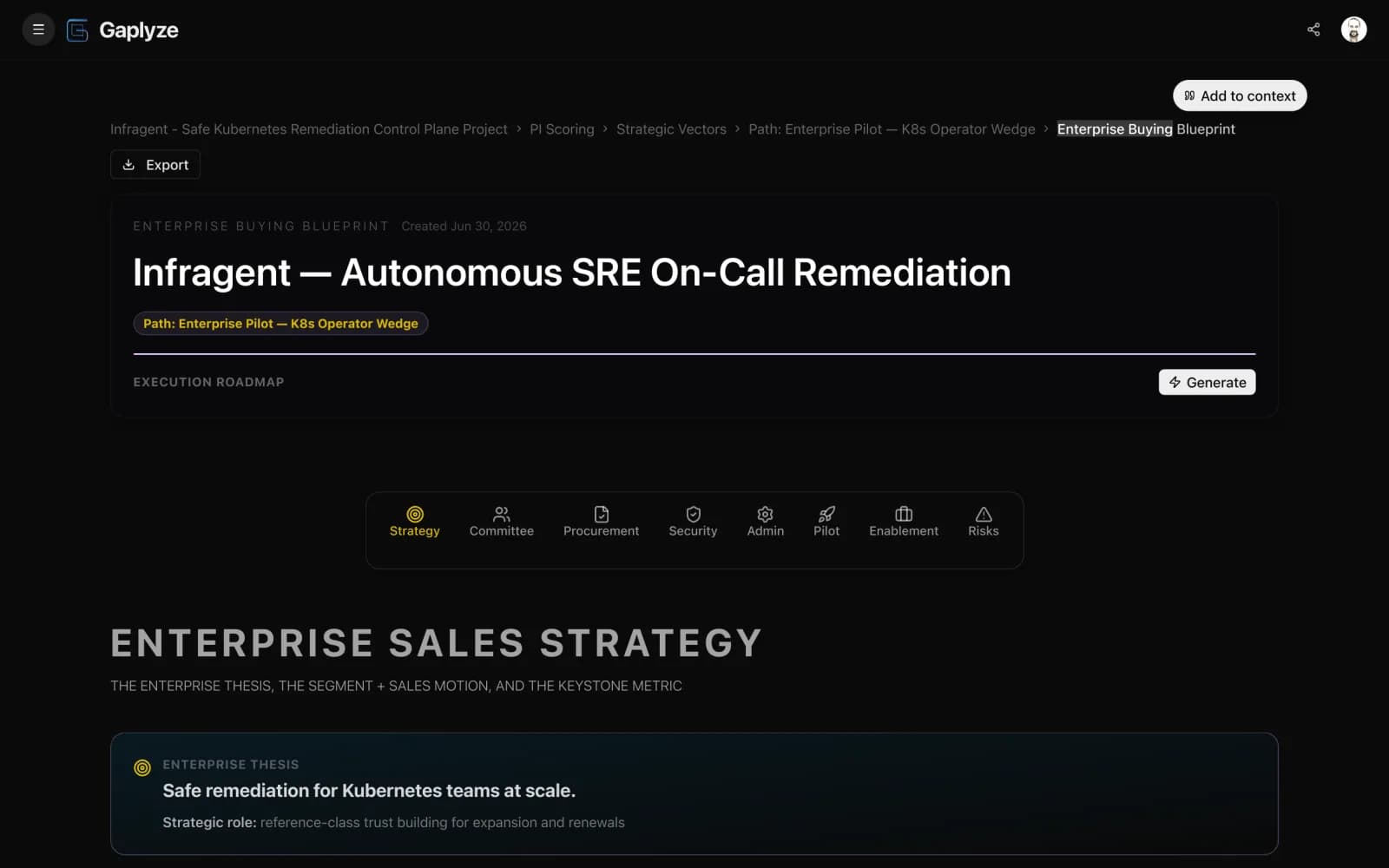
The actual Enterprise Buying Blueprint — the segment-positioning matrix, the compliance posture you can defend in security review, and the enablement stack for each pilot, production, and partnership stage. Open it and scroll the whole thing.
Roadmap outputs
From blueprint to delivery plan.
The execution roadmap sequences pilot, production, and partnership work into phases with dependencies — so sales, security, and engineering execute against the same calendar.
Phase 1
Pilot enablement
POC kit + security questionnaire pre-fill
Phase 2
Production readiness
SOC2 prep + reference architecture + MSA
Phase 3
Partnership program
ABM motion + executive sponsorship + QBR cadence
Prompt-pack outputs
Briefs your AI coding agent can ship.
Every enterprise artifact becomes a context-rich brief — audience, stakeholder map, success criteria — so your AI coding agent drafts the right thing the first time.
Pilot kit brief — POC scoping + mutual close plan template
Security questionnaire brief — SOC2 / HIPAA / GDPR pre-fill structure
Reference architecture brief — admin / identity / tenancy diagram + write-up
ABM brief — target-list shape + signal triggers + multi-threaded outreach
Sibling blueprints
Pairs cleanly with — and stays distinct from — these.
GTM Blueprint
Broader acquisition motion across all segments
Non-overlap: GTM is the funnel for all buyers; Enterprise Buying is the deep motion for procurement-gated ones.
Business Model Blueprint
Commit-tier logic + unit economics behind the deals
Non-overlap: Business Model defines what an enterprise tier costs; Enterprise Buying defines how to close it.
Technical Blueprint
Admin, identity, and multi-tenancy capabilities
Non-overlap: Technical builds the controls; Enterprise Buying defines which controls each segment demands.
Regulatory and Trust Blueprint
Standing trust posture beyond any single deal
Non-overlap: Regulatory + Trust runs the always-on program; Enterprise Buying handles within-deal compliance.
Included with blueprints
Generate your first Enterprise Buying Blueprint.
Start free. Upgrade only when you want the full execution roadmap and prompt pack ready for your team and AI coding agent.
FAQ
Enterprise Buying Blueprint questions answered.
How is enterprise sales different from SMB?
Longer sales cycles (often 6-12 months), multiple stakeholders, procurement gates, security review, and a custom pilot before commit. The Enterprise Buying Blueprint frames each motion so you don't try to run an SMB playbook into a procurement-gated buyer.
Is compliance work worth the cost early?
Only the compliance items your target segments actually demand. The blueprint's Compliance Posture Matrix sorts SOC2 / ISO27001 / HIPAA / GDPR into required, in-progress, or N/A per segment — so you don't pay for ISO27001 before a customer ever asks.
What does a pilot-to-production motion look like?
A staged commitment ladder — pilot (paid POC with clear success criteria), production (signed annual contract), partnership (multi-year + co-marketing). The blueprint's Enablement Package Stack frames the artifacts each stage needs.
How long do enterprise procurement timelines typically take?
Security review takes 4-8 weeks, legal/MSA negotiation another 2-6 weeks, and procurement signoff 1-4 weeks. The blueprint frames the calendar so your team plans against a realistic close date.
What enablement materials does enterprise sales actually need?
Security questionnaire pre-fill, reference architecture, ROI model, executive briefing deck, mutual close plan, and a customer-reference one-pager. The Enablement Package Stack maps each artifact to the stage it unlocks.
Should I run account-based marketing from day one?
If your top 50 logos drive most of the addressable revenue, yes — and the blueprint frames the ABM motion (target list + signal triggers + multi-threaded outreach). If your TAM is broader, the GTM Blueprint sits upstream of this one.
Enter procurement with the artifacts already in hand.
Generate the Enterprise Buying Blueprint built on your scored idea — and run every deal with the segmentation, posture, and enablement your buyer expects.