
Turn a Competitor's Website Into Your Wedge
A repeatable competitor analysis method: take a single competitor URL, turn it into a scored gap report, and read it to find your wedge — the narrow, defensible entry point an incumbent has left wide open.
Table of Contents
Competitor Analysis That Finds Your Wedge, Fast
The fastest way to find your wedge is to run competitor analysis on the incumbent's own website. A competitor's homepage, pricing page, and feature list are a free brief on the market: who the customer is, what the category looks like, what the product does well — and, by omission, what it refuses to do. Those omissions are the outline of your wedge: the narrow, specific entry point where a focused newcomer can win before a bigger company can react.
The method is three moves. First, take one competitor URL and turn it into a scored gap report instead of skimming the site by eye. Second, read the report for the three things that actually expose an opening — the underserved audience, the missing capability, and the positioning angle the incumbent will not take. Third, sharpen that opening into a single-sentence wedge and pressure-test it against the wider competitive landscape so you are entering through a real seam, not a wall.
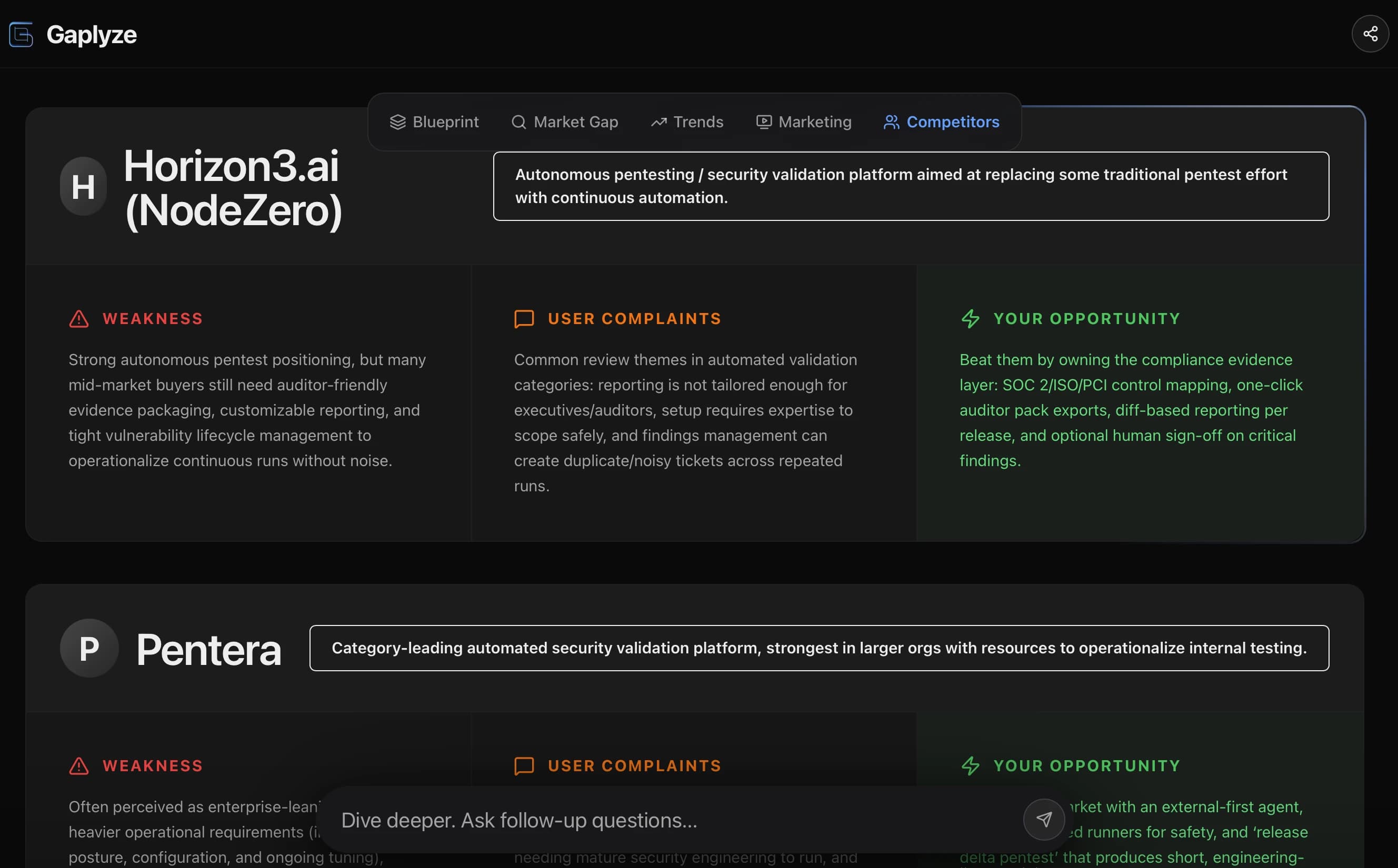
This is the move Gaplyze's Web Insights automates. You paste a competitor's URL and it analyzes the site into a scored opportunity report with specific, impact-estimated recommendations — surfacing the underserved audiences, missing capabilities, and positioning gaps the incumbent has left open, alongside a read on the moat and customer sentiment. Strategic Vectors then maps that single competitor against the broader landscape and its whitespace, so the seam you spotted on one site is confirmed against the market as a whole.
The instinct 'a competitor exists, so the market is taken' is backwards. An established competitor is the strongest proof the market is real and someone is already paying. What it does NOT do — the segment it ignores, the feature its reviews keep begging for, the buyer it never speaks to — is a map of where that proven demand is going unmet. Your job is to read the map, not retreat from it.
What a Wedge Is (and Why You Need One)
A wedge is a deliberately narrow entry point into a market — one specific audience, one painful job, or one missing capability that you serve better than anyone, before you expand outward. It is the opposite of building a broad 'competitor but better' product. Against an incumbent with more engineers, more budget, and more brand, a head-on fight is one you lose by default. A wedge changes the terms: you are not trying to be better at everything, only undeniable at one thing the incumbent has chosen to ignore.
Wedges work because large products are optimized for their majority. To serve the mainstream profitably, an incumbent has to say no to edge segments, niche workflows, and features that do not move its core metric. Each of those nos is a door. The classic startup pattern is to walk through the smallest door — the segment everyone else thinks is too small to bother with — own it completely, earn trust and a foothold, and then expand into adjacent demand from a position of strength.
The hard part is not believing in wedges; it is finding the right one. A wedge that is too broad puts you back in a head-on fight. A wedge that is too narrow has no path to expansion. The reliable way to land in between is evidence: read the incumbent's site and reviews for where real demand is colliding with a real gap, then name the single opening that is both winnable today and expandable tomorrow.
Reading a Competitor's Site Into a Scored Gap Report
Manual competitor analysis is slow and biased. You open the homepage, form an impression, and your impression is shaped by whatever the marketing team chose to foreground. The site is designed to show strength and hide gaps — so reading it by eye tends to confirm 'they've got it covered' rather than expose where they don't. A structured, scored report fixes this by forcing every part of the analysis into the same frame, so weaknesses surface instead of staying buried under good copy.
Gaplyze's Web Insights does exactly this: paste a competitor's URL and it returns a scored opportunity report with specific, impact-estimated recommendations. Rather than a vague 'they seem strong,' you get a structured read on what the incumbent is, who it serves, how defensible it looks, what its users actually feel, and — most usefully — the concrete gaps it has left open, each with a sense of how much opportunity it represents.
Three parts of that report do the heavy lifting for finding a wedge. The moat read tells you how defensible the incumbent really is — a thin moat means you can attack directly, a deep one means you route around it through a segment it cannot easily follow you into. The sentiment read surfaces how customers actually feel underneath the marketing, where frustration and unmet expectation cluster. And the gap map names the specific openings — underserved audiences, missing capabilities, and positioning angles — that are the raw material of your wedge.
Because the report is scored on Gaplyze's consistent nine-tier framework — the same calibration used across idea rating, generation, and the domain rater — a strength of seventy means the same thing on every site you analyze. That lets you run the same move on three or four competitors and compare their gap reports like a portfolio, instead of holding four fuzzy, non-comparable impressions in your head.
The homepage tells you what the incumbent wants you to believe; the reviews tell you the truth. Every recurring one-star complaint that names a missing capability is a feature gap, and every 'I love it but I had to switch because…' is an underserved-segment gap. Web Insights' sentiment read points you at where this frustration concentrates — that's where the proven demand is leaking, and where a sharp wedge plugs in.
The Three Gap Types That Become Wedges
Not every gap is a wedge. A useful gap report sorts openings into the few shapes that actually translate into a defensible entry point, so you can tell a real seam from a feature you'd simply be nice to add. Three types matter most when you are reading a single competitor's site.
Underserved-audience gaps: the incumbent serves the mainstream well but speaks past a specific segment — solo founders, a particular industry, a non-English market, a budget tier it has priced out, or a workflow that doesn't fit its core persona. These are often the strongest wedges because the incumbent structurally cannot chase the segment without diluting its main product. Feature gaps: the category exists, the reviews are loud about a missing capability, and the incumbent is too big or too slow to ship it — the gap is real, named by customers, and ignored.
Positioning gaps: the product is capable but aimed at the wrong buyer, priced for a different tier, or framed in a way that leaves a clear angle open — 'the affordable, focused alternative,' 'the one built for this exact role,' 'the transparent option in a category people distrust.' A positioning wedge doesn't require a different product so much as a sharper story aimed at demand the incumbent's framing leaves on the table. Web Insights surfaces all three; your job is to pick the one opening where demand is provable and the incumbent's response is structurally slow.
“Don't try to out-build the incumbent. Find the corner of its market it can't be bothered to serve — and own it completely before it notices.”
Turn a competitor's URL into a scored gap report
Paste a competitor's website into Web Insights and Gaplyze analyzes it into a scored opportunity report — moat, customer sentiment, and the specific underserved audiences, missing capabilities, and positioning gaps it has left open, each with impact-estimated recommendations.
From Competitor URL to a Sharper Positioning Wedge
Pick the incumbent that defines the category
Start with the competitor your target customers already compare everyone else against. Its site is the richest brief on the market — and because it sets the category's expectations, the gaps it leaves are the gaps the whole category leaves. Grab the URL.
Turn the URL into a scored gap report
Run Web Insights on that URL. Instead of skimming the homepage, you get a scored opportunity report: what the incumbent is, how defensible its moat looks, how its customers actually feel, and the specific underserved audiences, missing capabilities, and positioning gaps it has left open.
Read for the three wedge-shaped openings
Scan the report for the underserved audience, the missing capability, and the positioning angle the incumbent won't take. Cross-check against the sentiment read — the opening that lines up with real, recurring customer frustration is the one with proven demand behind it.
Confirm the seam against the full landscape
Run Strategic Vectors on your strongest opening. It maps the single competitor against a real landscape of five competitors with a positioning map and whitespace, so you confirm the gap is genuine market thin-space — not a hole one rival left that two others already fill.
Write the wedge in one sentence
Compress the finding into a single sentence: 'For [underserved audience], the [missing capability or sharper position] that [the incumbent] won't build.' That sentence is your wedge — the narrow, defensible angle you enter through, with the evidence behind every clause.
Why a Validated Market Beats an Empty One
It feels safer to chase a market with no competitors, but an empty market is usually empty for a reason: no proven demand, no buyers educated to pay, no category that customers already understand. A crowded market with a clear wedge is frequently the better bet, because the hardest part — convincing people the problem is worth paying to solve — is already done. The incumbent has spent years and millions validating the demand for you; you just need a sharper angle into it.
This reframes competitor analysis from defensive to offensive. You are not studying a rival to see whether you're allowed to enter; you are reading its site to find the exact coordinates where proven demand meets an unserved need. A scored gap report makes those coordinates explicit — here is the audience it ignores, here is the capability its reviews beg for, here is the position it can't credibly take — so your entry is aimed, not hopeful.
It also keeps you honest. Because Gaplyze threads your own reality — team size, budget, runway, stage, geography — through every artifact via its Project Framing memory, a wedge isn't assessed for a hypothetical founder; it's assessed for you. A funded team and a bootstrapped solo founder should attack completely different seams in the same market, and the right wedge is the one that is both real in the gap report and winnable from where you actually stand.
The most common mistake is spotting one missing feature and declaring it a wedge. A single feature is easy to copy and easy for the incumbent to ship the week you launch. A real wedge is a feature plus an audience the incumbent can't profitably serve, or a position it can't credibly claim — something structural that buys you time to build a foothold. Read the gap report for the seam, not just the checkbox.
Make Competitor-to-Wedge a Repeatable Habit
Finding a wedge is not a one-time stroke of insight; it is a move you get faster at every time you run it. Run the same loop on the top two or three players in any space you're considering — URL to scored gap report, read for the three openings, confirm against the landscape, write the one-sentence wedge — and the patterns start jumping out. You learn to spot a thin moat, a frustrated segment, or a lazy position at a glance.
The discipline pays off twice. Up front, it stops you from talking yourself into a head-on fight or a feature-sized 'wedge' that isn't one. Later, it becomes an audit you can re-run: as the incumbent ships and pivots, its gaps move, and re-running Web Insights keeps your wedge — and your positioning — pointed at where the market is actually thin today, not where it was thin a year ago.
Start with one competitor you already lose sleep over. Turn its URL into a scored gap report, read where its moat is thin and its customers are frustrated, and write down the single seam you could own. That sentence — grounded in the incumbent's own site rather than your hope — is the difference between 'the market is taken' and 'here is exactly where it's open, and here's my way in.'
Written by
Eli AbdeenFounder of Gaplyze — the product-intelligence OS that turns raw ideas into investor-ready product bets. More about the team →
Keep Exploring
Find your wedge in a competitor's own website.
Paste a competitor URL and Gaplyze turns it into a scored gap report — moat, customer sentiment, and the underserved audiences, missing capabilities, and positioning gaps it leaves open — then confirms your wedge against a real competitive landscape, all in one workspace.
Frequently Asked Questions
How do I turn a competitor's website into a startup idea?+
Read the site for what the competitor doesn't do, not just what it does. Its ignored segments, missing features, and the complaints in its reviews outline a validated market with an open seam. Gaplyze's Web Insights automates this: paste a competitor URL and it returns a scored opportunity report — moat, customer sentiment, and the specific underserved audiences, missing capabilities, and positioning gaps the incumbent has left open, each with impact-estimated recommendations you can build a wedge around.
What is a startup wedge?+
A wedge is a deliberately narrow entry point into a market — one specific audience, painful job, or missing capability you serve better than anyone before expanding outward. It avoids a head-on fight with a larger, better-resourced incumbent by attacking a corner the incumbent has structurally chosen to ignore. You own that corner, earn a foothold and trust, then expand into adjacent demand from a position of strength rather than competing on every feature at once.
How do I do competitor analysis to find a market gap?+
Skim-reading a competitor's homepage is biased — the site is designed to show strength and hide gaps. Instead, turn the analysis into a scored, structured report so weaknesses surface. Gaplyze's Web Insights takes a competitor URL and scores it on a consistent nine-tier framework, reading the moat, customer sentiment, and the concrete gaps the incumbent leaves open. Because it's scored consistently, you can run it on several competitors and compare their gap reports side by side instead of relying on fuzzy impressions.
Isn't a market with strong competitors already taken?+
Usually the opposite. An empty market is often empty because demand was never proven; a crowded market means buyers already understand the problem and pay to solve it — the hardest work is done. The opportunity is the seam where proven demand meets an unmet need. A scored gap report makes that seam explicit, so a validated market with a clear wedge is frequently a better bet than an empty one where you'd have to educate the market from scratch.
How is finding a wedge different from copying a competitor's features?+
A single feature is easy to copy and easy for the incumbent to ship the week you launch, so a feature alone is not a wedge. A real wedge pairs the opening with something structural — an audience the incumbent can't profitably serve, or a position it can't credibly claim — that buys you time to build a foothold. Gaplyze's Web Insights surfaces the gaps, and Strategic Vectors confirms the seam against a real competitive landscape and its whitespace, so you enter on a defensible angle, not a copyable checkbox.