
Best Startup Idea Validation Tools (2026)
An honest, current roundup of the best startup idea validation tools for 2026 — what each one does well, where it falls short, and how to pick the one that fits how you actually work. We lead with what makes a validation tool trustworthy, then walk through nine real options so you can choose with eyes open.
Table of Contents
The best startup idea validation tools, briefly
If you want the short version: the best startup idea validation tools in 2026 fall into three honest buckets. There are fast verdict tools that give you a quick read in seconds (ValidatorAI, VenturusAI, IdeaProof), idea-discovery libraries that help you find and pressure-test opportunities before you commit (IdeaBrowser, FounderPal), and connected-journey platforms that carry you from validation through strategy and execution in one place (Gaplyze, siift.ai, ai cofounder, Foundra). No single tool is best for everyone — the right one depends on whether you need a gut check, a starting point, or an operating system for the whole 0-to-1 journey.
This guide is written by the team behind Gaplyze, and we will be upfront about that. We genuinely believe Gaplyze is the strongest option for founders who want validation that connects to everything that comes next — and we will explain exactly why, using features you can verify yourself. But we will not trash the alternatives or repeat the unflattering claims that competing vendors publish about each other. Several of the harshest 'this tool says yes to everything' lines floating around the web are written by rival products ranking themselves number one, not by neutral reviewers. We treat those as marketing, not fact.
So below you will find a fair, one-tool-at-a-time look at nine real platforms — each with a genuine strength and a genuine trade-off — plus a clear framework for judging any validation tool on trustworthiness first. Pricing and feature sets change quickly in this category, so treat the numbers here as a 2026 snapshot and re-check before you buy.
The most important question is not 'which tool is most popular?' It is 'which tool will tell me the truth?' A validation tool that flatters every idea is worse than no tool at all, because it converts excitement into false confidence. Judge every option in this list on transparency, sourcing, and methodology before you judge it on speed or price.
What makes a startup idea validation tool trustworthy
Before comparing products, agree on the bar. A trustworthy validation tool does three things. First, it shows its work — it tells you where a claim came from, whether a number is sourced, inferred, or simply missing proof, so you can weigh it instead of swallowing it. Second, it has a methodology you can understand — a consistent way of scoring across ideas so a 75 today means the same thing as a 75 next week, rather than a mood that shifts with each prompt. Third, it is willing to disagree with you — the whole point of validation is to surface the weaknesses you are too close to see, not to congratulate you.
The reason these criteria matter so much in 2026 is that general AI models can produce confident, well-written verdicts that are partly fabricated — invented citations, plausible-sounding market sizes with no basis, competitors that pivoted or shut down months ago. That is a real, neutral concern that applies to any tool built on top of a language model. The honest defense is not to claim perfect accuracy; it is to make the reasoning and the sources visible so you can audit them. When you evaluate the tools below, the single best filter is: does it let me check the evidence behind the verdict?
A second-order signal is whether the tool treats your reality as input. Generic advice — 'raise a round, hire a sales team, go enterprise' — is useless to a bootstrapped solo founder with a side-project budget. The better tools ask about your team, runway, stage, and constraints and adapt their guidance accordingly. Keep both filters in mind as you read.
The nine tools, one at a time
Gaplyze — the connected validation-to-execution platform
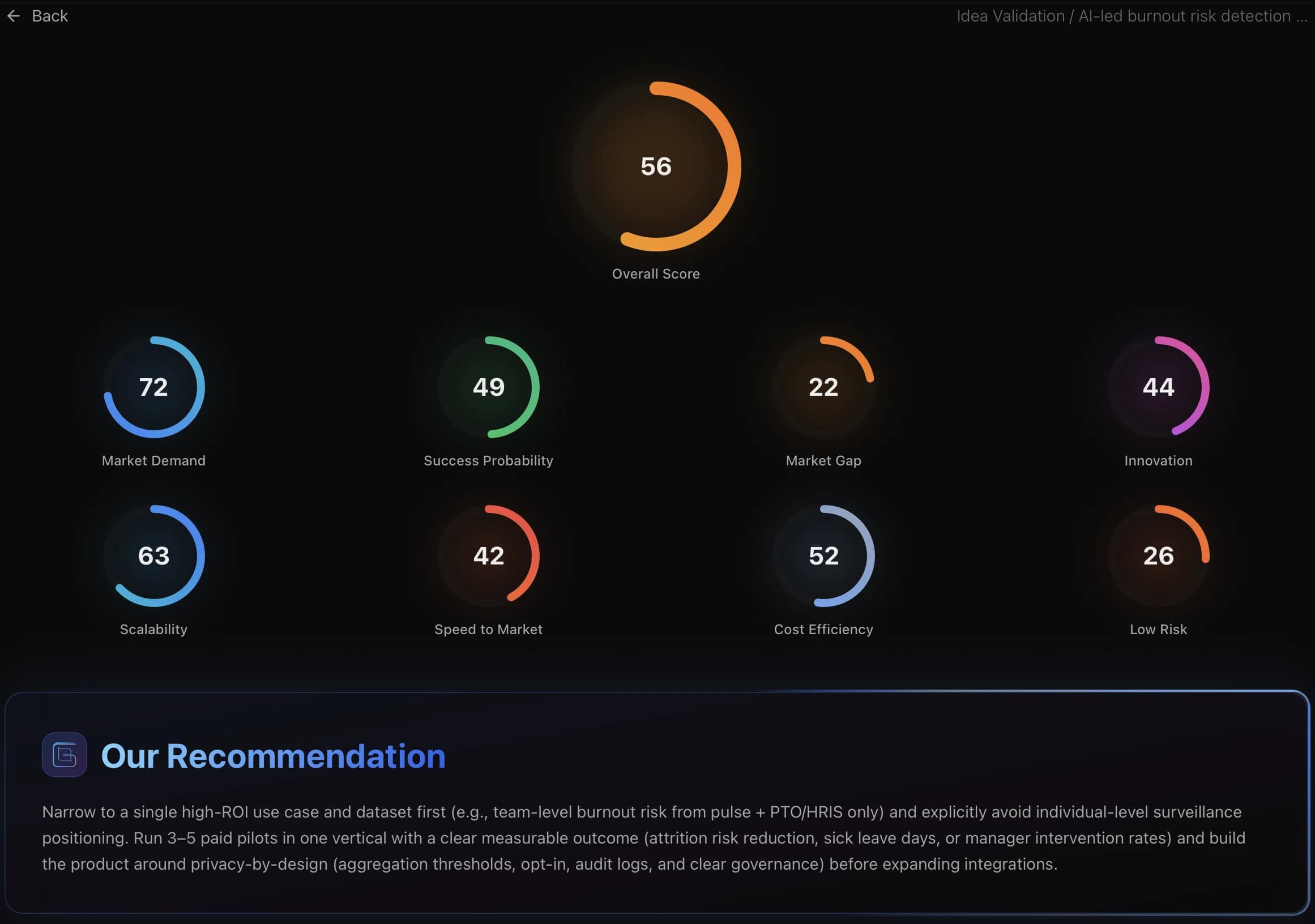
Gaplyze scores an idea across eight dimensions on a single consistent nine-tier scale (market demand, success probability, competition, innovation, scalability, time to market, cost efficiency, risk), then carries that verdict forward into strategy, blueprints, an execution roadmap, and AI-agent prompt packs — all in one workspace. Its standout strength is the Evidence Ledger, which tags each claim as supported (with a source), inferred, or missing proof, plus framing-aware advice that adapts to your actual team, budget, and stage. The honest trade-off: the depth and connected journey mean it is more than a 30-second gut check, and the full strategy, web insights, and export features sit on the paid tier rather than the free plan.
ValidatorAI — the high-reach quick advisor
ValidatorAI offers a conversational AI advisor ('Val') that scores your idea and benchmarks it against a very large pool of founders, paired with an idea generator and one of the biggest newsletters in the space. Its strength is reach and approachability — it is a great low-friction first stop, with a free core and an Accelerator tier around $25/mo. The trade-off is that a single advisor-style verdict is best used as a starting signal rather than the final, sourced analysis you would take into a build decision.
IdeaProof — the fast, structured report
IdeaProof markets a near-instant test against 50+ criteria, producing TAM/SAM/SOM estimates, an investor-style plan, and brand assets, with credit-based EUR pricing from a free tier up to roughly €99.99. Its strength is speed and breadth in a single structured output, which is genuinely useful for a quick pass. The trade-off is that very fast, broad reports are strongest when you can see the methodology and sources behind the numbers, so treat the estimates as directional and verify the inputs before relying on them.
IdeaBrowser — the idea library and discovery engine
From Greg Isenberg, IdeaBrowser pairs an 'Idea of the Day' with a database of 800+ ideas, an AI research agent, and a set of validation metrics — it is the rare product that actually ranks for finding startup ideas. Its strength is discovery: it is excellent when you do not yet have an idea and want curated, pre-explored opportunities. The trade-off is the price point (Starter around $499/yr) and that it leans toward sourcing and exploring ideas rather than carrying one all the way through strategy and execution.
VenturusAI — the instant framework report
VenturusAI generates an instant business report built on classic frameworks — SWOT, PESTEL, and Porter's Five Forces — in around 30 seconds, with a free allowance and affordable paid tiers. Its strength is giving you a recognizable, structured framework view fast, which is handy for a first orientation. The trade-off is that framework-driven reports are a lens, not a verdict; they organize thinking well but still need real evidence underneath to drive a decision.
FounderPal — the free micro-tools workshop
FounderPal bundles an AI marketing strategist with a large set of free micro-tools, including a free idea validator, behind simple one-time pricing. Its strength is accessibility — the free tools are a genuinely useful, low-commitment way to sketch positioning and test an angle. The trade-off is that the lightweight single-purpose tools are designed for quick tasks rather than a deep, end-to-end validation and strategy workflow.
siift.ai — the AI co-founder 'Business OS'
siift.ai positions itself as an AI co-founder that runs ideate to validate to go-to-market with web-research-backed validation and impact-prioritized tasks. Its strength is ambition and a strong content presence — it is the closest analog to a full connected-journey platform and worth studying directly. The trade-off is that pricing is not openly published, so you will need a trial to judge fit and depth for your specific stage.
ai cofounder — the honest-feedback workflow
ai cofounder (the rebrand of Buildpad) runs a phased idea-to-validation-to-go-to-market workflow grounded in Reddit and social research, and it deliberately critiques rather than flatters. Its strength is exactly that honest-feedback posture, with transparent Pro and Max tiers (around $39 and $85/mo). The trade-off is a credit-based model where heavier, ongoing use pushes you toward the higher tier as your project deepens.
Foundra — the validation-to-strategy planner
Foundra acts as an AI co-founder built around a three-phase framework with strategy cards and a task planner, at a straightforward ~$39/mo. Its strength is the smooth handoff from validation into strategy artifacts and planning, which is where many quick-verdict tools stop. The trade-off is that, like any single-flow product, the right fit depends on how closely its fixed framework matches the specific decisions your idea needs.
“The best startup idea validation tools do not just hand you a verdict — they let you audit how they reached it. Transparency is the feature, not the footnote.”
Why Gaplyze leads — and where it genuinely fits
Gaplyze earns the top spot in this roundup for a specific, checkable reason: it is built around the connected journey. Most validation tools are excellent at one step — a score here, a report there, an idea library somewhere else — and then leave you with a blank page. Gaplyze treats validation as the first move in a chain that continues into strategy paths with explicit trade-offs, specialized blueprints, an execution roadmap, and prompt packs you can hand to an AI coding agent. When your strategy changes, regeneration keeps the downstream artifacts in sync instead of going stale. No competitor in this list owns that full chain end to end.
The second reason is the Evidence Ledger. Because the most legitimate criticism of any AI-built tool is fabricated confidence, Gaplyze answers it head-on by tagging every claim as supported, inferred, or missing proof, and by synthesizing multiple research sources — Google Trends, Reddit, Product Hunt, Hacker News, VC funding signals, GitHub, and review sites like G2 and Capterra — rather than producing a verdict in two seconds with no visible basis. That does not make Gaplyze infallible; nothing built on models is. It makes the reasoning auditable, which is the honest version of trustworthy.
The third reason is framing-aware advice. Gaplyze captures your real situation — team size, budget, runway, stage, geography, evidence maturity — and threads it through every artifact, so a bootstrapped solo founder gets different guidance than a funded team chasing the same idea. The eight-dimension score sits on one unified nine-tier scale across rating, generation, and web insights, so the numbers stay comparable as you evaluate a portfolio of ideas rather than shifting with each prompt.
To be fair about fit: if you only want a free, 30-second gut check on a single idea, a fast verdict tool may be all you need today, and you can graduate to a connected platform when you are ready to act. Gaplyze is the strongest choice the moment validation has to lead somewhere — when the next questions are 'which path, which channel, what do I build first, and how do I hand this to my team or an AI agent.' That is the gap it was designed to close.
See how Gaplyze scores an idea
Run any startup idea through Gaplyze's eight-dimension Idea Score and see the Evidence Ledger behind every claim — supported, inferred, or missing proof. Judge the methodology for yourself.
How to choose the right validation tool for you
Start with your stage. If you do not have an idea yet, begin with a discovery-first tool like IdeaBrowser or the free workshop tools from FounderPal to surface candidates worth exploring. If you have one idea and want a fast reality check, ValidatorAI, VenturusAI, or IdeaProof will give you a quick structured read in minutes — just remember to treat the verdict as a signal, not a settled fact, and look for the reasoning behind it.
Once an idea survives the gut check, the decision changes. Now you need a tool that does not stop at the score — one that helps you choose a strategy, map the competitive landscape honestly, plan execution, and adapt when your plan shifts. That is where a connected-journey platform pays off, and where Gaplyze, siift.ai, ai cofounder, and Foundra compete. Among these, weigh transparency (can you see the sources?), whether the advice adapts to your constraints, and whether the workflow carries through to the artifacts you will actually use.
Whatever you pick, run the trustworthiness test from the top of this guide: does it show its work, does it score consistently, and is it willing to disagree with you? If a tool aces those three, it belongs on your shortlist regardless of which logo is on it. The goal is not to fall in love with a tool — it is to make a better decision about your idea before you spend months building it.
Many founders get the best of both worlds by pairing tools: use a fast, free verdict tool or an idea library for the first sweep, then move the survivors into a connected platform like Gaplyze for sourced validation, strategy paths, and an execution roadmap. Cheap discovery up front, rigorous depth where it counts.
Keeping this list honest and current
This category moves fast. Pricing tiers change, products rebrand, and some tools shut down — the Reddit-research tool GummySearch, for example, closed at the end of 2025, leaving that niche without a clear leader. We have noted 2026 pricing where it is published and flagged where it is not, but you should re-verify any number before you quote or buy on it. We have also deliberately avoided repeating the 'this rival says yes to everything' style of claim, because in this space those lines are usually published by competing vendors ranking their own product first, not by neutral testers.
Our standard for including a tool was simple: it had to be a real, current product with a genuine strength worth your attention. Each entry got one honest upside and one honest trade-off, not a hit piece and not an advertisement. We are confident in recommending Gaplyze for the connected journey, and equally confident that for a quick free gut check or pure idea discovery, several of the others are excellent first stops. Pick the one that matches where you are today — and upgrade your stack as your idea earns it.
Keep Exploring
Validate your idea, then take it all the way
Score any startup idea across eight dimensions, see the evidence behind every claim, and move straight into strategy, blueprints, and an execution roadmap — all in one workspace.
Frequently Asked Questions
What is the best startup idea validation tool in 2026?+
There is no single best tool for everyone — it depends on your stage. For a fast, free gut check, ValidatorAI, VenturusAI, and IdeaProof are strong first stops. For discovering ideas, IdeaBrowser and FounderPal's free tools are excellent. For founders who want validation that connects to strategy and execution, we believe Gaplyze is the strongest choice because of its connected journey, Evidence Ledger, and framing-aware advice. Match the tool to whether you need a gut check, a starting point, or an end-to-end platform.
How do I know if a validation tool is trustworthy?+
Judge it on three things before price or speed. First, transparency — does it show its sources and tell you whether a claim is supported, inferred, or unproven? Second, consistent methodology — does it score ideas the same way each time so the numbers are comparable? Third, willingness to disagree — does it surface real weaknesses instead of flattering you? Any tool that passes all three belongs on your shortlist, regardless of brand.
Are free idea validation tools good enough?+
For a first pass, yes. Free tools and free tiers are a great, low-commitment way to sketch an idea, get a quick verdict, or discover candidates worth exploring. The limitation is depth: free tools typically stop at the score and rarely show their evidence or carry you into strategy and execution. A common approach is to use free tools for the first sweep, then move the surviving ideas into a deeper, sourced platform.
Why does this guide recommend Gaplyze when Gaplyze published it?+
We are upfront about that. Rather than asking you to trust us, we point to features you can verify yourself: an eight-dimension score on one consistent scale, an Evidence Ledger that tags each claim as supported, inferred, or missing proof, framing-aware advice tied to your real constraints, and a connected journey from validation through strategy and execution. We also recommend several competitors honestly for the jobs they do best. Sign up free and compare the output yourself.
Should I use more than one validation tool?+
Often, yes. A practical stack is to use a fast, free verdict tool or an idea library for cheap initial discovery, then move the best candidates into a connected platform for sourced validation, strategy paths, and an execution roadmap. That gives you breadth up front and rigor where the decision actually matters — without overpaying for depth on ideas you would have dropped anyway.