
How Gaplyze Validates SaaS Business Ideas
An in-depth look at Gaplyze's ''Idea Score'' methodology. What each of the eight scoring dimensions measures, how the SWOT analysis reveals strengths and vulnerabilities, and how to use dimensional profiles to make confident go/no-go decisions.
Table of Contents
Why Gaplyze Uses Eight Dimensions Instead of One
Ask someone to rate your idea on a scale of 1 to 10, and you get a number. That number feels useful. It is not. A single score collapses all the complexity of market opportunity, competitive dynamics, execution feasibility, and innovation potential into one dimension. It tells you nothing about why the score is what it is, nothing about which aspects are strong, and nothing about what to improve.
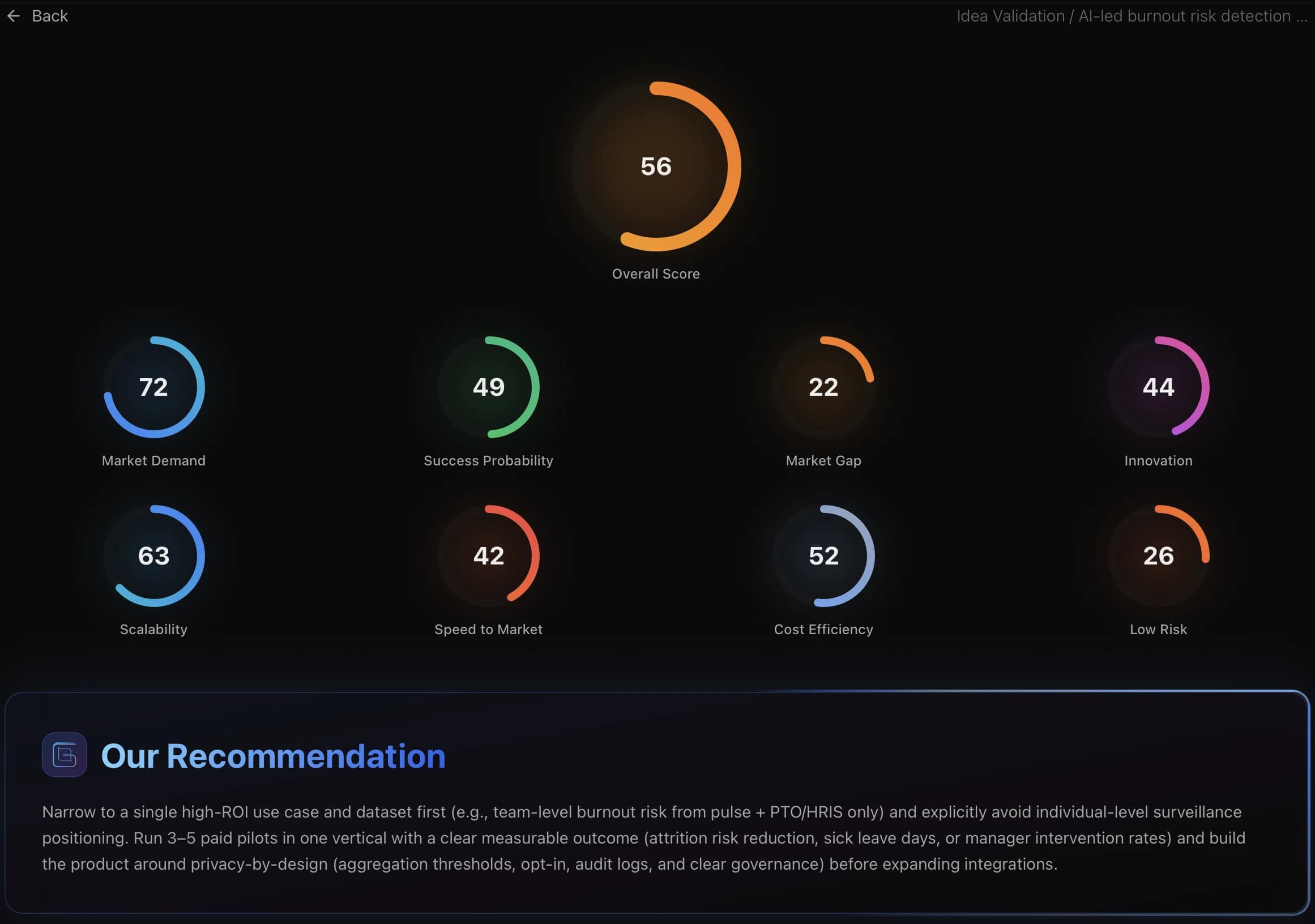
Gaplyze's Idea Score rejects the single-score approach entirely. Instead, it evaluates every idea across eight distinct dimensions — each capturing a different aspect of the opportunity. The combination creates a profile: a shape that tells you not just how good an idea is, but why it is good, where it is vulnerable, and what you can do about it.
This multi-dimensional approach is what makes Gaplyze's scoring actionable. When you see that your idea scores high on market demand but low on execution feasibility, you have a specific question to answer. When you compare two ideas and one dominates on five dimensions while the other leads on three, you have a meaningful conversation about strategy. Single scores close conversations. Gaplyze's eight dimensions open them.
Gaplyze's Idea Score does not produce a pass/fail verdict. It produces a structured conversation about your idea. High demand but low feasibility is a conversation about execution strategy. High innovation but low market readiness is a conversation about timing. Gaplyze's scores surface the right questions — your judgement answers them.
The Eight Dimensions of Gaplyze's Idea Score
Market Demand (0-100)
Gaplyze evaluates the strength and direction of market demand: Are people actively seeking a solution? Is demand growing, stable, or declining? Are there clear signals of willingness to pay? This dimension synthesizes search volume trends, community discussion patterns, and industry growth indicators. A high market demand score in Gaplyze means the problem is real, recognized, and commercially relevant.
Success Probability (0-100)
Gaplyze assesses the overall likelihood of success based on market conditions, timing, and competitive dynamics. This dimension synthesizes multiple factors: Is the market timing right? Is the problem urgent enough to drive adoption? Are the conditions favorable for a new entrant? A high success probability score reflects a convergence of positive signals across the market landscape.
Competition Level (0-100)
Gaplyze maps the competitive landscape: How many competitors exist? How well-funded are they? How entrenched are they? Higher scores mean MORE competitors — this dimension is inversely weighted in the overall assessment. Zero competition is also a warning signal in Gaplyze's analysis. The ideal score reflects moderate competition with identifiable gaps you can exploit.
Innovation Potential (0-100)
Gaplyze evaluates how much room exists for a genuinely differentiated approach. Can you solve the problem in a fundamentally better way? Is there space for architectural innovation, not just incremental improvement? High innovation potential in Gaplyze's scoring means the opportunity supports a product that is different in kind, not just degree.
Scalability (0-100)
Gaplyze assesses the growth trajectory: Can the product serve a growing market without proportional cost increases? Does the model support geographic expansion, vertical expansion, or platform extension? A high scalability score in Gaplyze means the idea can grow into a substantial business, not just a niche tool.
Time to Market (0-100)
Gaplyze evaluates speed to a viable first version. Higher scores mean LONGER time to market — this dimension is inversely weighted. Shorter time to market means faster feedback, faster iteration, and lower upfront risk. Gaplyze penalizes ideas that require extended development before delivering any value.
Cost Efficiency (0-100)
Gaplyze measures capital efficiency: What are the expected costs relative to revenue potential? Can the idea be bootstrapped or does it require extensive fundraising? Higher cost efficiency in Gaplyze's scoring means you can build a sustainable business without heavy capital requirements.
Risk Level (0-100)
Gaplyze identifies and quantifies key risks: regulatory, technical, market timing, competitive response, and dependency risks. Higher scores mean MORE risk — this dimension is inversely weighted. Gaplyze's goal is not to eliminate risk but to make it visible: what risks exist, how likely they are, and whether they can be mitigated.
“A high overall score with one weak dimension is more informative than a moderate score across all dimensions. Gaplyze's dimensional breakdown tells you exactly what to investigate, strengthen, or mitigate.”
How Gaplyze's SWOT Analysis Complements the Scores
Idea Score does not stop at numerical scores. Every evaluation includes a complete SWOT analysis — Strengths, Weaknesses, Opportunities, and Threats — with a weighted recommendation that synthesizes all eight dimensions.
Gaplyze's SWOT adds the qualitative context that numbers alone cannot provide. The scores tell you that competition is high (Competition Level: 78). The SWOT Threats section tells you why — naming specific competitors, their funding levels, and their market positions. The scores tell you feasibility is moderate. The SWOT Weaknesses section tells you which specific challenges affect feasibility and whether they are solvable.
The weighted recommendation synthesizes everything into actionable guidance. Based on the dimensional profile and SWOT analysis, Gaplyze provides a clear signal about whether to proceed, refine, or reconsider — with specific reasoning that traces back to the evidence. This is not a hedged opinion. It is a structured assessment you can trust because you can see exactly how it was derived.
How Dimensional Patterns Reveal Opportunity Types
Gaplyze's eight dimensions interact in patterns that reveal deeper insights. Understanding these patterns turns Idea Score from a scoring tool into a strategic intelligence instrument.
High demand combined with low competition is Gaplyze's clearest signal of opportunity — a growing market with room for new entrants. This pattern often indicates an emerging category that incumbents have not yet recognized or have deliberately ignored.
High demand combined with high competition is a positioning signal — the market is proven, but winning requires precise differentiation. When Gaplyze shows this pattern, the Market Intelligence becomes critical: the Market Gap Analyzer reveals exactly where to differentiate.
High innovation combined with low success probability is a timing signal — the opportunity may be real, but the market is not ready. Gaplyze flags these ideas as worth monitoring. When market conditions shift, the opportunity may become actionable — and Gaplyze's rescoring will reflect the change.
Low risk combined with low innovation is a commoditization signal — the opportunity is safe but undifferentiated. Gaplyze's analysis helps you decide whether to pursue (if you want steady revenue) or pass (if you need a defensible position).
Score your idea across all eight dimensions
Enter any SaaS idea into Gaplyze's Idea Score and get eight-dimension scoring, SWOT analysis, and a weighted recommendation — all in minutes.
Using Gaplyze to Compare Ideas Side by Side
The greatest value of Idea Score emerges when you score multiple ideas. A single idea gives you a profile. Multiple ideas give you perspective — you see what strong demand actually looks like, what genuine innovation potential feels like, and where your assumptions about feasibility were wrong.
Gaplyze's structured scoring makes comparison meaningful. Two ideas might have the same overall score but radically different profiles — one might be high-demand, high-competition, while the other is moderate-demand, low-competition. They represent fundamentally different strategies. Gaplyze's dimensional breakdown reveals exactly how they differ.
Portfolio comparison on Gaplyze also reveals surprises. The idea you were most excited about often scores differently than expected. The idea you almost dismissed sometimes scores highest on the dimensions that matter most. Idea Score surfaces what enthusiasm obscures — and that corrective function is precisely the point.
Gaplyze recommends scoring all your projects before reviewing results. If you see the first score, every subsequent idea feels 'good' or 'bad' relative to that anchor. Scoring all ideas first prevents anchoring bias and produces genuine comparative insight. Gaplyze's scores mean more when you see them in context.
When to Go Deeper: From Idea Score to Market Intelligence
Idea Score is designed as the first filter in Gaplyze's workflow. Strong scores on Idea Score signal that an idea is worth the deeper investment of a full Market Intelligence.
Proceed to Market Intelligence when multiple dimensions score strongly and the SWOT analysis shows addressable weaknesses. Gaplyze's Market Intelligence will then map the competitive landscape in detail, run the seven-component Market Gap Analyzer, and produce a business blueprint with specific positioning and strategy.
Refine first when the SWOT reveals a specific weakness that could be addressed by repositioning. Gaplyze's follow-up chat can help you explore repositioning angles before committing to a full Market Intelligence.
Pass when multiple dimensions score poorly with no clear mitigation. Idea Score's dimensional breakdown tells you exactly why — and saves you from investing hours in deep analysis on an idea with fundamental structural problems.
Use Gaplyze's SWOT output as a direct input to your product planning. Strengths become your marketing differentiators. Weaknesses become risks to mitigate in your execution roadmap. Opportunities become features to prioritize. Threats become competitive responses to prepare for. Gaplyze's SWOT is not an academic exercise — it is a strategic action plan waiting to be executed.
Building Scoring Intuition with Gaplyze
Idea Score is most powerful as a recurring practice. The first time you score an idea on Gaplyze, you learn about that idea. The fifth time, you learn about scoring itself — you develop calibration, recognizing what strong demand signals actually look like, what healthy competition patterns feel like, and what genuine innovation potential means.
This calibration is the compound interest of structured validation. Experienced Gaplyze users can glance at a scoring profile and immediately identify the opportunity pattern: 'This is a timing play — high potential, low current demand, monitor and revisit.' Or: 'This is a positioning play — high demand, high competition, needs a precise niche.'
Start building this skill now. Score your current idea with Idea Score. Then score two or three alternatives. Compare the profiles. Notice which dimensions surprised you. Notice where your intuition was confirmed and where it was challenged. Each scoring exercise on Gaplyze makes your next evaluation faster and more accurate.
Keep Exploring
See what Gaplyze's eight dimensions reveal about your idea.
Enter any SaaS idea into Idea Score and get eight-dimension scoring, SWOT analysis, and a weighted recommendation. Compare multiple ideas. Find the opportunity your intuition missed.
Frequently Asked Questions
How does Gaplyze determine the score for each dimension?+
Gaplyze's AI engine analyzes the idea across multiple factors for each dimension — market signals, competitive data, feasibility indicators, innovation markers, and risk factors. Each dimension receives a score from 0-100 with specific reasoning that explains what drove the evaluation.
Can I trust a single Idea Score score to make a business decision?+
No — and Gaplyze is designed to prevent that. Always examine the eight-dimension breakdown and SWOT analysis. The value of Idea Score is the structured conversation it creates: which dimensions are strong, which are weak, and what the patterns reveal. Use Gaplyze's scores to inform your judgement, not replace it.
What if my idea scores low on Idea Score but I believe in it?+
Low scores do not mean the idea is bad — they mean the current formulation has identifiable weaknesses. Examine which dimensions scored low in Gaplyze's breakdown and read the SWOT analysis. Sometimes the fix is repositioning. Sometimes it is timing. Use Gaplyze's follow-up chat to explore alternatives before dismissing the idea entirely.
How often should I rescore the same idea on Gaplyze?+
Rescore after making meaningful changes — pivoting the audience, adjusting pricing, or discovering new market information. Also rescore when market conditions shift: new competitors, regulatory changes, or technology developments. Gaplyze's scores are snapshots. Regular rescoring keeps your intelligence current.
Why are some dimensions inversely weighted?+
Competition, Time to Market, and Risk are inversely weighted because higher values in these dimensions represent challenges. High competition means more barriers. Longer time to market means higher upfront risk. Higher risk means more uncertainty. Inverse weighting ensures that Gaplyze's overall assessment accurately reflects opportunity attractiveness — higher is always better.